PSY 355 Psychology & Media in
the Digital Age
This page was last modified on February 6, 2026
|
|
PSY 355 Psychology & Media in
the Digital Age
This page was last modified on February 6, 2026 |
Evaluating Claims About Psychology and Media
- Are video games causing young people to become more violent?
- Is social media making young people less able to think for themselves?
- Is social media causing us (and particularly younger people) to experience increased levels of depression?
- Does long exposure to the screens of digital devices by children and preteens cause changes in brain wiring?
Are any of these claims true? How should we go about evaluating them?
("Opinion vs. Evidence...," 2009)
- Are claims filled with statements to provoke strong emotion? condemnation? fear? praise or endorsement? predictions of disaster/doom OR unlimited possibilities? Emotional claims often mask or hide the absence of real evidence.
- All good or all bad?
- Financial or other conflicts of interest by those making the claim? Are there any political motives or conflicts associated with the claim?
- Strength of research supporting the claim?
- Experts may disagree about a conclusion in science
- Extraordinary claims require extraordinary evidence (ECREE or the "Carl Sagan Standard")
- Invoked by the astronomer Carl Sagan in 1979 to challenge claims of paranormal phenomena such as levitation, alien spacecraft coming to Earth, astral projection (out of body travel by the soul), etc.
- Related to the notion that the burden of proof lies on the person who is making a factual claim that contradicts commonly-accepted realities
- Note, though, that it is not always clear what is meant by "extraordinary" as a claim or as evidence.
- "An extraordinary claim is one that is contradicted by a massive amount of existing evidence" (Deming, 2016, p. 1329)
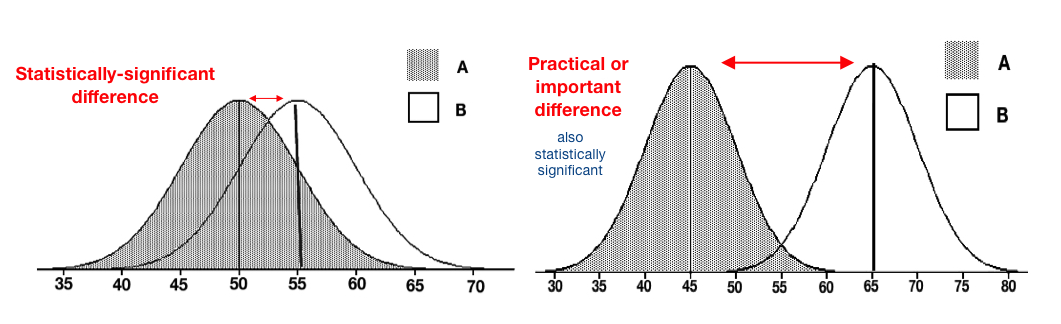
- Statistical versus practical difference
- Statistical significant difference = confidence two groups are distinctive, but
- Difference is not necessarily important or has any practical implications
- For example, the difference in height between the men of two different nations may be statistically significant. The average male US soldier in 1980 was 5' 10 1/2" (179 cm) and the average male Italian soldier was 5' 8 1/2" (174 cm). For practical purposes that 2 inch difference probably doesn't have much of an effect on their ability to serve as soldiers.
Conspiracy Theories & Conspiratorial Thinking
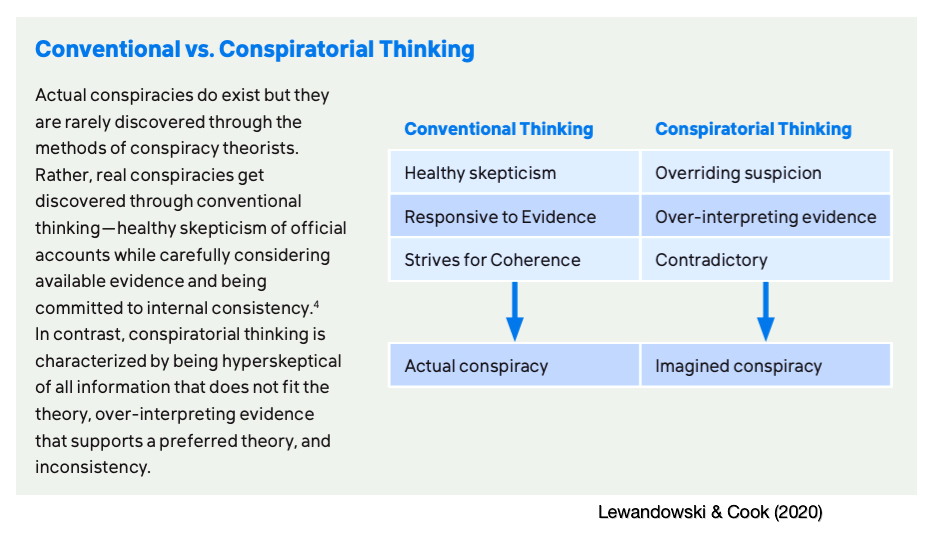
(Lewandowski & Cook, 2020)
"Real conspiracies do exist. Volkswagen conspired to cheat emissions tests for their diesel engines. The U.S. National Security Agency secretly spied on civilian internet users. The tobacco industry deceived the public about the harmful health effects of smoking. We know about these conspiracies through internal industry documents, government investigations, or whistleblowers" (p. 3)
However
- Was COVID-19 actually created by the drug industry and medicine to make money?
- Was the 2020 Presidential Election stolen from Donald Trump by election fraud including rigged Dominion voting machines switching votes from Trump to Biden and suspiciously high turnout in Democratic strongholds? [* see additional comments below]
- Did Hillary Clinton & other top Democrats run a child-kidnapping ring using an underground network below a pizza restaurant in Washington DC where they would kill the children and use their blood as a drug against aging? The "Pizzagate Conspiracy Theory" (** see QAnon below)
- Was the mass shooting at Sandy Hook Elementary School which supposedly killed 26 people (including 20 children) on December 14, 2012 actually "completely fake" and a "giant hoax" perpetrated by opponents of the 2nd Amendment's right to carry arms with child crisis actors hired to pretend to be harmed (while no one actually died)? Claimed by Alex Jones on InfoWars. (One of several conspiracy theories about what happened)
- Was Barack Obama actually born in Kenya in Africa even though there is a long-form State of Hawaii birth certificate showing his birth in Honolulu in 1961?
- Was Melania Trump, the First Lady, replaced by a body double because she is either dead, refused to attend events with her husband, or decided to leave public life completely?
- Did Elvis Presley fake his own death in 1977 in order to escape from being killed by the Mafia whom he was spying on for the FBI?
All of these are examples of "conspiracy theories" which, in the digital age, have been promoted far more widely than was ever true in earlier periods (although it is not clear that the number of conspiracy theories are now being promoted are more than in the past, see Uscinski & Enders, 2023). These theories each reflect what is called "conspiratorial thinking" by those who promote them.
As Lewandowski & Cook (2020) summarize, there are seven major traits (what they call "CONSPIR") that most conspiracy theory demonstrate:
- Contradictory: Believing simultaneously in ideas that are mutually contradictory, e.g., the 9/11 attack on the Pentagon was done by both Islamic terrorists and planned by the US government
- Overriding Suspicion: A complete rejection of any belief in any official accounts that don't fit with the conspiracy theory, e.g., Obama's Hawaii 1961 birth certificate was made-up only when he became President in 2009.
- Nefarious Intent: The motivation behind any conspiracy is always for something evil or nefarious, never for positive goals.
- Something Must Be Wrong: If some parts of the theory can no longer be held, the overall theory must be right because "something must be wrong" and any official accounts are deceptions.
- Persecuted Victim: Conspiracy theorists see themselves as persecuted victims while at the same time they are brave heroes challenging what is wrong.
- Immune to Evidence. Clear evidence against a conspiracy theory is really just originating from the conspiracy itself, e.g., if the FBI presents records that contradict the conspiracy, then the FBI is itself part of the conspiracy.
- Re-interpreting Randomness. Nothing in the world happens by accident. A random event is re-interpreted as part of the conspiracy, e.g., no plane hit the Pentagon on 9/11 because there were intact windows in the building and any real attack would have broken all the windows.
* Trump & the 2020 Presidential Election (Eggersa et al., 2021)
"Claims Based on Facts That Are Not Actually FactsQAnon (2017-present)
• Dominion Voting Machines Do Not Decrease Trump Vote Share.
• Absentee Ballot Counting Procedures Do Not Decrease Trump Vote Share.
• Turnout Was Not Unusually High in Counties Where Republicans Made Fraud Accusations."
"We have closely examined what we consider the most prominent statistical claims of fraud in the 2020 election. Although the claims are diverse, our conclusion is consistent: For each claim, we find that what is purported to be an anomalous fact about the election result is either not a fact or not anomalous. In many cases the alleged fact, if shown to withstand scrutiny, would hardly constitute convincing evidence that Biden was elected due to fraud: A modest advantage to Biden in counties that chose to use Dominion machines, for example, could be explained by chance, by factors not accounted for in statistical models, or indeed by pro-Trump fraud undertaken using other voting machines. As it happens, the allegedly anomalous features we consider appear mundane once properly measured or placed in the appropriate context (p. 6; emphasis added).
QAnon is a far-right American political conspiracy theory and political movement that originated in 2017. QAnon centers on fabricated claims made by an anonymous individual or individuals known as "Q". Those claims have been relayed and developed by online communities and influencers. QAnon's core beliefs are that
- the world is controlled by a secret cabal of Satan-worshipping child molesters,
- Trump is secretly battling to stop them, and
The cabal is thought to cover up its existence by controlling politicians, mainstream media, and Hollywood. Q's revelations imply that the cabal's destruction is imminent but also that it will be accomplished only with the support of the "patriots" of the QAnon community. This will happen at a time known as "the Event" or "the Storm", when thousands of people will be arrested and possibly sent to Guantanamo Bay prison or face military tribunals. The U.S. military will then take over the country, and the result will be salvation and utopia. (from Wikipedia, Feb. 2, 2026)
- Q reveals details about the battle online.
Lateral Reading: An Approach to Evaluating Internet/Digital Data
(Wineberg & McGrew, 2017)
How do professional fact checkers for newspapers and other companies -- whose jobs depend upon being right -- evaluate digital information found on the Internet? An excellent study of how they achieve accuracy (compared to undergraduate students who often do not) was conducted by Wineberg & McGrew (2017). Here are some of their observations:
- Taking Bearings: Before diving too deeply into unfamiliar digital content, make a plan for moving forward…websites do not sprout by spontaneous generation but are designed, created, and financed by groups seeking to promote particular—and often partisan—interests. Taking bearings helped [professional fact] checkers get a fix on these interests. In an Internet teeming with cloaked sites and astroturfers (front groups pretending to be grassroots efforts), taking bearings often assumes the form of lateral reading.
- When reading laterally, one leaves a website and opens new tabs along a horizontal axis in order to use the resources of the Internet to learn more about a site and its claims.
- Lateral reading contrasts with vertical reading. Reading vertically, our eyes go up and down a screen to evaluate the features of a site. Does it look professional, free of typos and banner ads? Does it quote well-known sources? Are bias or faulty logic detectable? In contrast, lateral readers paid little attention to such features, leaping off a site after a few seconds and opening new tabs. They investigated a site by leaving it.
Some of the sites visited might include Wikipedia, a Google search, Snopes (snopes.com), Lead Stories (leadstories.com), PolitiFact (politifact.com), and other sources.
Sort Fact from Fiction Online with Lateral Reading [3'47"]
(YouTube video produced by COR Civic Online Reasoning)
According to COR Civic Online Reasoning, the basic questions to be asked and discovered are
- Fact checkers also possessed knowledge of online structures, particularly how search results are organized and presented.
- They knew that the first result was not necessarily the most authoritative, and they spent time scrolling through results, often scanning the entire first page (and sometimes the second and third) before clicking on any links. They understood how search engine optimizers use sophisticated keywords and other techniques to game results, pushing some sites to the front of the line and more authoritative information to the back.
1. Who's behind the information?
2. What's the evidence?
3. What do other sources say?
COR has posted online for free an entire curriculum to train users of the Internet how to deal with online information
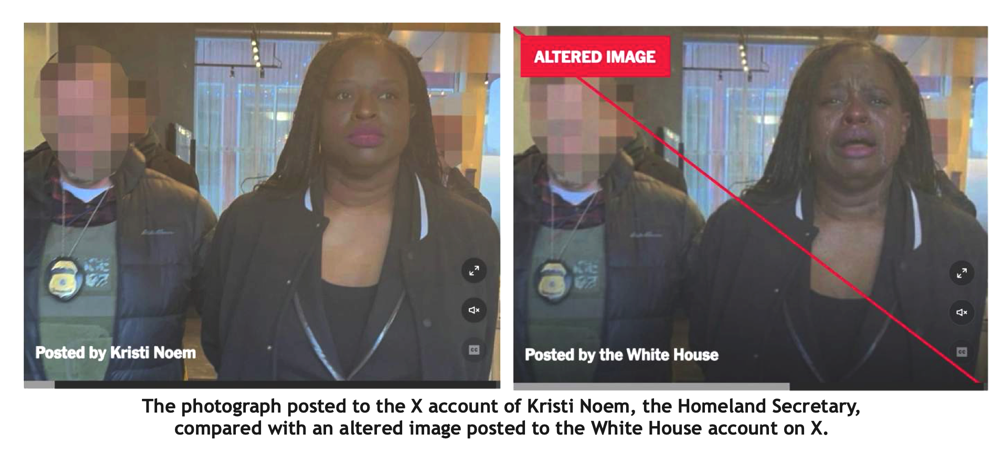
Altered Image via AI
On January 22, 2026, the New York Times reported:
The White House posted a digitally altered image showing a demonstrator involved in interrupting a church service in Minnesota last weekend crying as she was arrested on Thursday [Jan 15, 2026]. A previous version of the image, also posted by an official government account, showed her looking forward calmly…The Justice Department said on Thursday morning that it had taken the demonstrator, Nekima Levy Armstrong, a lawyer, into custody, accusing her of helping to interrupt a church service in St. Paul, Minn., on Sunday. Demonstrators had gathered on Sunday to protest a pastor’s apparent connection to Immigration and Customs Enforcement.
Moral Panics
(Cohen, 1973/2011, p. 9; also, Bonn, 2015)
The Great Comic Book Panic of the early 1950s
The impact of digital media is frequently described as strongly negative, e.g., we are becoming "addicted," children and adults are losing their cognitive abilities such as verbal skills or knowledge of essential world information; we are distracted most of the time; interpersonal relationships are being harmed; people are being subject to cyberbullying or other forms of harassment which is harming them, etc.
Are these claims forms of what can be termed a "moral panic" in which the media itself has become the threat to society?
- = "A condition, episode, person or groups of persons emerges to become defined as a threat to societal values and interests "
- its nature is presented in a stylized and stereotypical fashion by the mass media
- the moral barricades are manned by editors, bishops, politicians and other right-thinking people
- socially accredited experts pronounce their diagnoses and solutions
- ways of coping are evolved or (more often) resorted to
- the condition then disappears, submerges, or deteriorates...
- "Marijuana Menace" (MJ as "narcotic") 1900s-1930s
- The infiltration of the United States by Communists (early 1950s)
- Juvenile delinquency & youth violence on the rise in the 1950s
- Video games & violence 1970s-today
- Increasing crime in the United States: 1970s-today (crime increase stopped in 1990; rose again around the time of COVID in 2020, but has resumed decreasing in the last two years)
- War on Drugs 1970s-today
- Popular music undermining children’s behavior (too much violence, drugs, sex) according to the Parents Music Resource Center (PMRC; Tipper Gore) & need for parental warning labels for music 1985
- Dungeons & Dragons (Fantasy Role Playing Games) 1980s-1990s
- Satanic Ritual Abuse 1980s-1990s
- HIV as “gay plague” 1980s-today
- "Harry Potter" books/movies as promoting witchcraft and satanic values 2000s
References
Bonn, S. A. (2015, July). Moral panic: Who benefits from public fear? PsychologyToday.com. https://www.psychologytoday.com/blog/wicked-deeds/201507/moral-panic-who-benefits-public-fear
Cohen, S. (2011). Folk devils and moral panics: The creation of the Mods and the Rockers. London, UK: Routledge. (Original work published 1973).
Deming, D. (2016). Do extraordinary claims require extraordinary evidence? Philosophia, 44, 1319-1331. https://doi.org/10.1007/s11406-016-9779-7
Center for Climate Change Communication, George Mason University. Available at https://skepticalscience.com/conspiracy-theory-handbook-downloads-translations.html
Eggersa, A. C., Garrob, H., & Grimmer, J. (2021). No evidence for systematic voter fraud: A guide to statistical claims about the 2020 election. PNAS, 118 (45), e2103619118 https://doi.org/10.1073/pnas.2103619118
Opinion vs. Evidence—What is the difference? (2009). Utah State University: National Center for Hearing Assessment and Management. https://www.infanthearing.org/meeting/ehdi2009/EHDI%202009%20Presentations/185.pdf
Uscinski, J. E., & Enders, A. M. (2023) Conspiracy theories: A primer (2nd ed.). New York: Rowman & Littlefield.
Wineberg, S., & McGrew, S. (2017). Lateral reading: Reading less and learning more when evaluating digital information. Working Paper No. 2017.a1. Stanford History Education Group. https://papers.ssrn.com/sol3/Delivery.cfm?abstractid=3048994
This page was first posted on 2/12/2018