PSY 355 Psychology & Media
in the Digital Age
This page was last modified on May 3, 2026
|
|
PSY 355 Psychology & Media
in the Digital Age
This page was last modified on May 3, 2026 |
Digital Abstinence: Some Consideration of What is Happening
What happens when digital technology is taken away?
- How do we feel?
- How do we cope?
Coyne & Woodruff (2023) Study: Taking a Break: The Effects of Partaking in a Two-Week Social Media Digital Detox on Problematic Smartphone and Social Media Use, and Other Health-Related Outcomes among Young Adults.
- Exploratory study recruited 43 Ontario Canadian college students of whom 27 completed the entire research protocol
- Protocol
- (a) 2-week baseline period (how much time did students regularly spend online),
- (b) 2-week digital abstinence period (participants were limited to no more than 30 minutes per day online), and
- (c) 2-week post abstinence period which included completing questionnaires and an exit interview
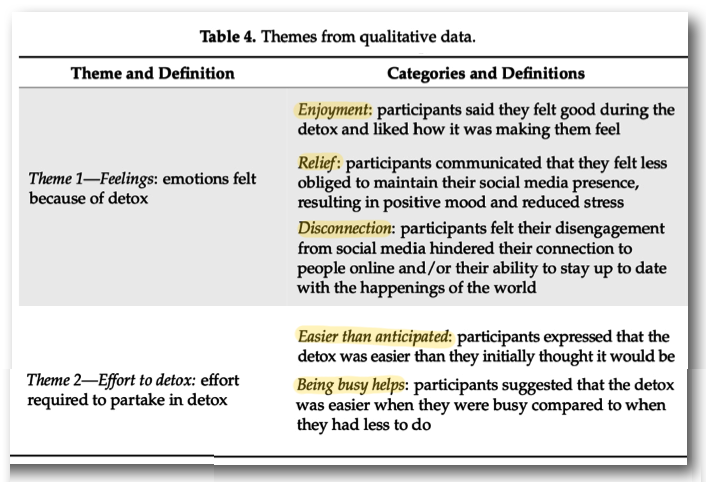
- Qualitative Findings from Interviews of Participants (there were many quantitative results, but I want to focus on these)
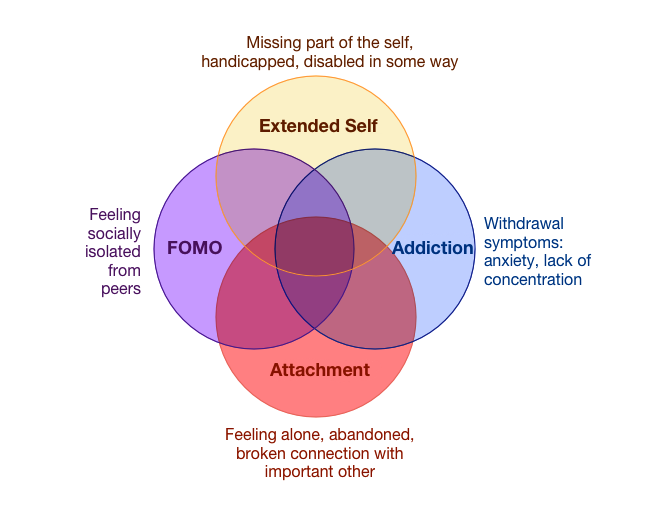
Four perspectives from Psychology on Going Without Digital Media
1. Extended Self Hypothesis: Everyday objects become intimate parts of who we are
2. Psychological Dynamic of the FOMO (Fear of Missing Out)
- As we grow accustomed to everyday objects and their functions as part of ourselves, the absence of these objects and functions can be experienced as the loss of part of ourselves.
- Essential needs in childhood, adolescence, and early adulthood include relationships with others
- “Fear of missing out (FoMO) is defined as an apprehension or concern of being disconnected, absent or missing an experience which others (i.e., peers, friends, family) might receive.” Experiencing FoMO arises in many individuals who are “likely to be engrossed in psychological demands toward begin connected, related and intimate with others” (Dhir et al., 2018, p. 143)
3. Attachment Hypothesis: Portable digital devices, esp. cellphones, become "attachment objects"
- FoMO is frequently in competition with “social media fatigue…mental exhaustion after experiencing various technological, informative and communicative overloads through their participation and interactions one the different online social media platforms” (Dhir et al., 2018, p. 142)
- "Many children form strong emotional attachments to teddy bears, blankets or pillows where they become
distressed if they are separated" (Lee & Hood, 2021, p. 72). The object(s) psychologically represent for the child a bond with a loved parent, usually the mother. And, if the object is lost, the child unconsciously feels as if the parent is also lost and becomes upset.4. Addiction Hypothesis: Repeated use of digital media can lead to addiction and, therefore, tolerance & withdrawal symptoms may arise if these media are no longer available.
- Researchers have suggested that users can develop very personal bonds or attachments to both their digital devices & the functions those devices allow them to carry out, e.g., always having a connection to loved ones, returning to pleasant experiences, etc. (Koles & Nagy, 2021). If such devices and their functions are unavailable, a user can become uneasy or feel as if they have lost an important connection.
In small groups of 4 or 5, discuss the following questions:
- How did you feel? Did you find yourself uneasy? Frustrated? Bored? Free? Relaxed? Anxious?
- Did you find yourself thinking about what you were missing? Did you feel isolated or disconnected?\
- Did you find any way of substituting for your usual digital diet, i.e., did you do anything differently that you would not have done otherwise?
- Were you able to carry out your responsibilities of daily life using other media forms?
- Did you find yourself craving media? How did your respond to any such craving?
- How did your friends, family, or other react to you in this period? Did they have anything to say?
References
Belk, R. (2016). Extended self and the digital world. Current Opinion in Psychology, 10, 50–54. https://doi.org/10.1016/j.copsyc.2015.11.003
Coyne, P. & Woodruff, S. J. (2023) Taking a Break: The Effects of Partaking in a Two-Week Social Media Digital Detox on Problematic Smartphone and Social Media Use, and Other Health-Related Outcomes among Young Adults. Behavioral Science, 13, 1004. https://doi.org/10.3390/bs13121004
Dhir, A., Yossatorn, Y., Kauer, P., & Chen, S. (2018). Online social media fatigue and psychological wellbeing—A study of compulsive use, fear of missing out, fatigue, anxiety and depression. International Journal of Information Management, 40, 141-152. https://doi.org/10.1016/j.ijinfomgt.2018.01.012
Koles, B., & Nagy, P. (2021). Digital object attachment. Current Opinion in Psychology, 39, 60-65. https://doi.org/10.1016/j.copsyc.2020.07.017
Lee, A., & Hood, B. (2021). The origins and development of attachment object behaviour. Current Opinion in Psychology, 39, 72-75. https://doi.org/10.1016/j.copsyc.2020.07.023