PSY 355 Psychology & Media in the
Digital Age
This page was last modified on March 22, 2026
|
|
PSY 355 Psychology & Media in the
Digital Age
This page was last modified on March 22, 2026 |
Artificial Intelligence and the Future of Human Affairs: Part 1
Summarizing where we have come from:
Every Technology Explained From 1970s to 2020s in 3 minutes | Office workplace tech history (YouTube)
Notice that this video ends by raising the latest innovative change, that is, Artificial Intelligence. So, let's turn to that topic this week.
What is Artificial Intelligence?
According to Google AI:
Artificial Intelligence (AI) is a branch of computer science that creates systems capable of performing complex tasks typically requiring human intelligence, such as reasoning, learning from experience, and recognizing patterns. It uses data, algorithms, and models to make decisions, automate processes, and solve problems.
Common Examples of Artificial Intelligence:
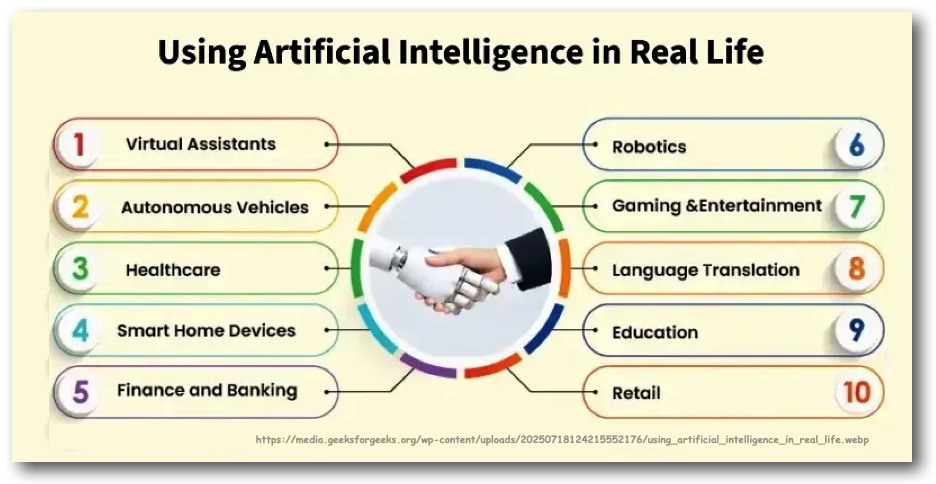
- Virtual Assistants: Siri, Alexa, and Google Assistant use natural language processing to understand and respond to voice commands.
- Recommendation Engines: Netflix, YouTube, and Spotify analyze your past behavior to suggest movies or music you might like.
- Generative AI: Systems like ChatGPT create human-like text, code, or images based on prompts.
- Self-Driving Cars: Autonomous vehicles, such as those from Tesla or Waymo, use sensors and computer vision to navigate roads.
- Facial Recognition: Systems like Apple’s FaceID use AI to identify individuals by analyzing facial features.
- Healthcare Diagnosis: AI tools analyze medical imagery (like X-rays or MRIs) to assist doctors in detecting diseases early.
- Spam Filters: Email platforms use AI to scan incoming messages and keep your inbox clean.
Even more specifically: Uses of Artificial Intelligence in Everyday Life (as we look at this link, I want you to write down whatever of these examples you have experienced)
QUESTION: Having reviewed these forms of AI, what is your specific experience or experiences with different forms of Artificial Intelligence?
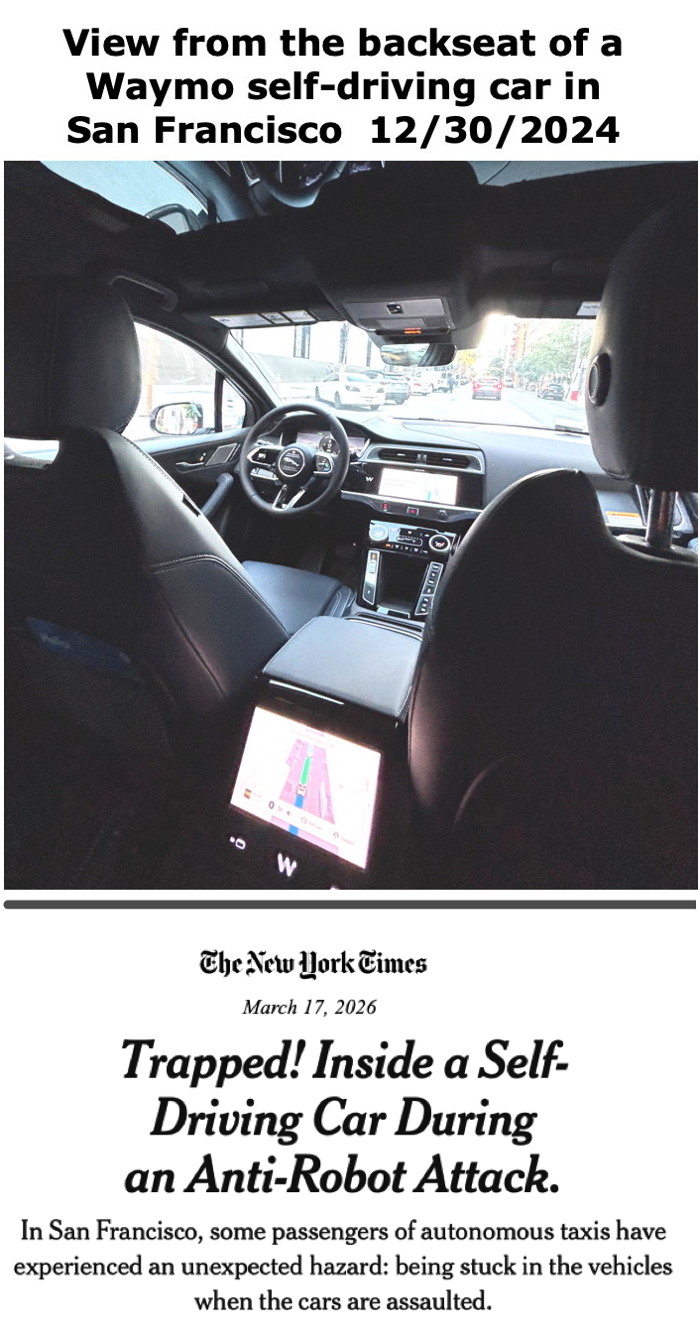
In our next class, we will look at how there can be significant problems with AI-based operations. Here would be one example: the self-driving car:
Waymo Self-Driving Cars
Waymo self-driving cars operate using a sophisticated suite of sensors—including LiDAR, radar, and cameras—combined with AI software to perceive, predict, and plan driving actions. The system, dubbed the "Waymo Driver," processes 360-degree environmental data in real-time, allowing it to navigate, obey traffic laws, and avoid obstacles without a human driver.
Key Components and Functioning:
As of 2026, Waymo vehicles have driven about 170 million fully autonomous miles on public roads. The fleet, operating in cities like Phoenix, San Francisco, and Los Angeles, provides more than 250,000 rides per week. The company reports that Waymo cars are involved in about 90% fewer accidents than human driven cars.
- Sensor Suite (Sense): The vehicle uses customized sensors to map its surroundings.
- LiDAR: Emits laser beams to create a detailed 3D, 360-degree view of the environment, identifying objects up to 300 meters away.
- Cameras: High-resolution cameras detect visual information like traffic lights, traffic signs, emergency vehicle lighting, and street details.
- Radar: Uses radio waves to measure the speed and direction of moving objects in various weather conditions, such as rain or fog.
- Computing and AI (Solve): An onboard, Intel-based AI system acts as the "brain," processing sensor data to recognize objects, predict their behavior, and make decisions in real-time.
- Navigation and Control (Go): The software maps the environment, analyzes traffic rules, and controls the vehicle's steering, braking, and acceleration.
- Mapping: Waymo creates detailed maps of its operating areas before launching, highlighting features like speed limits, lane markers, and intersections.
- Operational Procedures: Passengers unlock the car with an app, enter, and start the trip via a, user interface in the app. The system uses internal, audio sensors and cameras to ensure safety.
To learn more about Waymo, you can go to this link: https://www.thinkautonomous.ai/blog/how-googles-self-driving-cars-work/
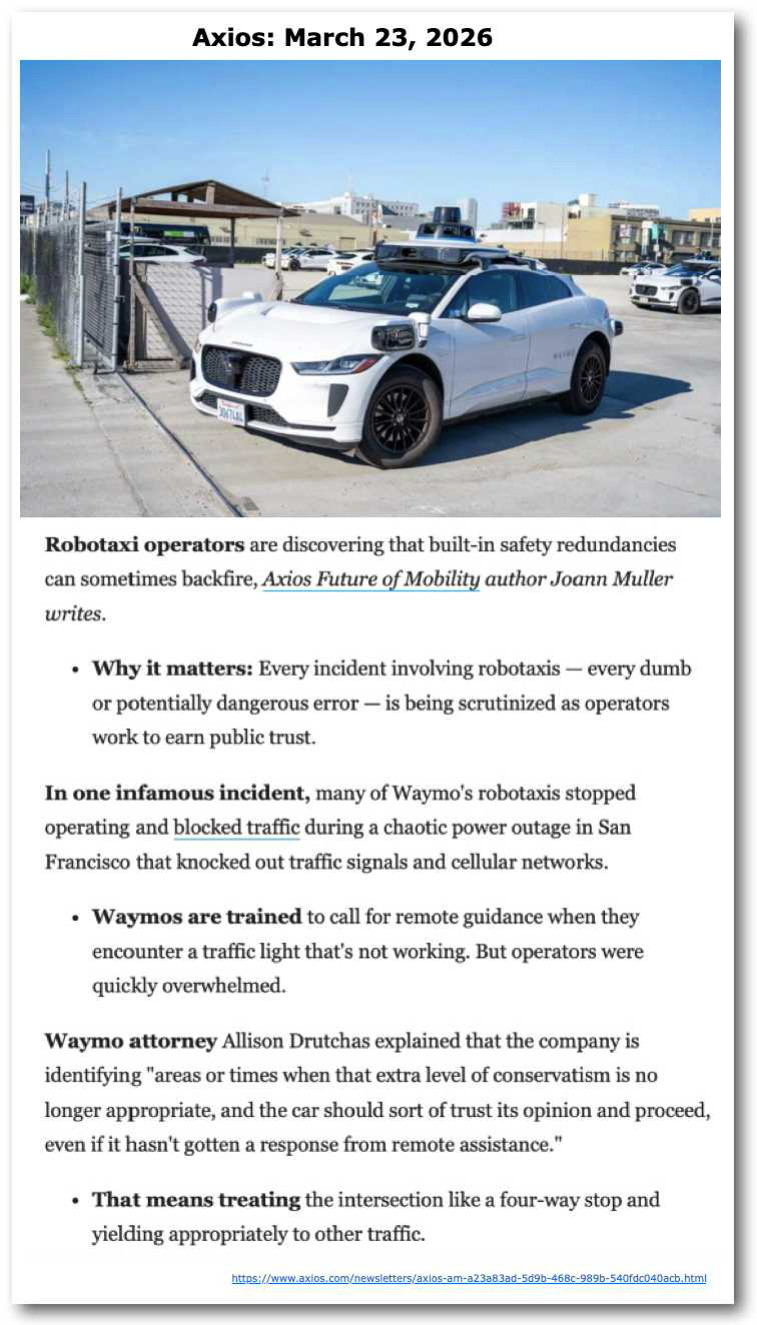
Nonetheless, there can be problems with a self-driving car:
How does Artificial Intelligence work? (from Claude AI)
At its heart, AI systems learn patterns from data and use those patterns to make decisions or predictions. Here's a diagram of the core pipeline:
The basic processes break down like this.
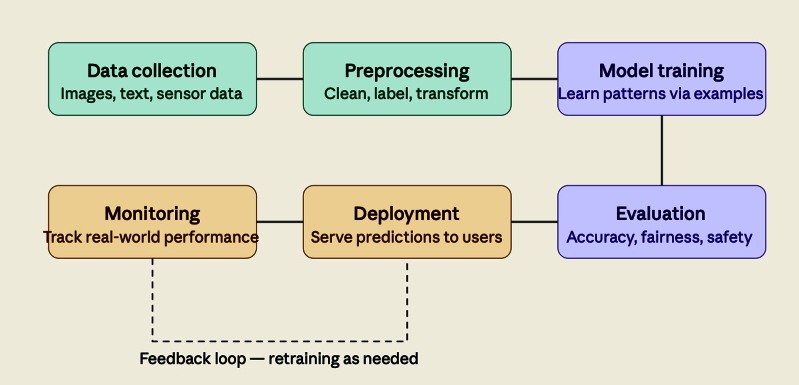
1. First comes data collection and preprocessing — AI systems require large volumes of examples to learn from. Raw data (images, text, numbers) must be cleaned, labeled, and formatted before a model can use it.
Where do the data come from that AI uses to learn from?
- Web scraping is the most common method for large-scale datasets. Text, images, and other content are harvested from websites, often using automated crawlers. The training data for large language models like me comes substantially from web scrapes (Common Crawl, for example, archives petabytes of web content).
- Ed.: 1 petabyte of data is 1 million gigabytes (GB) and equivalent to 250 million songs or 223,000 DVD movies or 500 billion pages of text [= everything in a large library. Estimates are that the human brain’s memory capacity is ca. 2.5 petabytes.
- Curated datasets are assembled by researchers and organizations for specific purposes — ImageNet for image recognition, Wikipedia dumps for language modeling, medical imaging repositories for diagnostic AI. These tend to be higher quality but much smaller in scale.
- Sensors and instruments generate continuous real-world data — cameras, microphones, GPS trackers, industrial sensors, satellite imagery, medical devices. Self-driving car programs, for instance, collect millions of miles of driving footage.
- Human-generated transactions include things people produce naturally as part of daily life: search queries, purchase histories, app usage patterns, social media activity. This data is often collected passively by platforms. Think, for example, all of your credit card purchases OR all of your searches when you go to Amazon or any other retailer online
- Synthetic data is artificially generated by simulations or other AI models. It's increasingly important when real data is scarce, expensive, or sensitive — for example, generating synthetic patient records to train medical AI without risking actual patient privacy.
- Human annotation is often required on top of raw data. People (called annotators or labelers) manually tag images, transcribe audio, rate responses, or classify examples. This is how "supervised" datasets get their labels, and it's an enormous, often invisible industry.
2. Then comes model training, where an algorithm iterates over the data thousands or millions of times, adjusting its internal parameters to minimize prediction errors.
3. After training, the model is evaluated against held-out data it hasn't seen, checking accuracy and checking for failures.
- The core idea: learning by being wrong. At its heart, training is a process of making predictions, measuring how wrong they are, and nudging the model in a direction that makes it less wrong. Repeat this millions or billions of times, and the model gradually gets better.
The foundational principle of model evaluation is simple: never test a model on data it was trained on. During training, a portion of the dataset — typically 10–20% — is set aside and never shown to the model. After training, performance is measured on this test set. If the model has genuinely learned generalizable patterns rather than memorized training examples, it should perform well on data it hasn't seen before.4. Once satisfactory, it's deployed in a real environment. Deployment is where AI moves from a research artifact into the real world — and where the gap between "works in the lab" and "works reliably at scale" becomes very apparent.
5. Then the model monitored continuously so that performance degradation or new problems can trigger retraining.
How accurate is AI in understanding what it is like to be a student in 2026?
I have distributed a 5-page summary that was generated by Gemini AI which compares students in 1976 (a few years after I graduated from college) with student today. Read through the summary and, considering your own experience, check of with a plus sign or √ (check mark) what seems accurate to you and a negative sign (-) for what seems inaccurate for you.