PSY 355 Psychology & Media in
the Digital Age
This page was last modified on March 4, 2026
|
|
PSY 355 Psychology & Media in
the Digital Age
This page was last modified on March 4, 2026 |
Jean Twenge: The Social Psychology of Generations and Media
Dr. Jean Twenge, a social psychologist who teaches at San Diego State University, has been studying how different generations in America behave and how they have been affected by technology. She has authored many articles and books. The three books we'll look at today are:
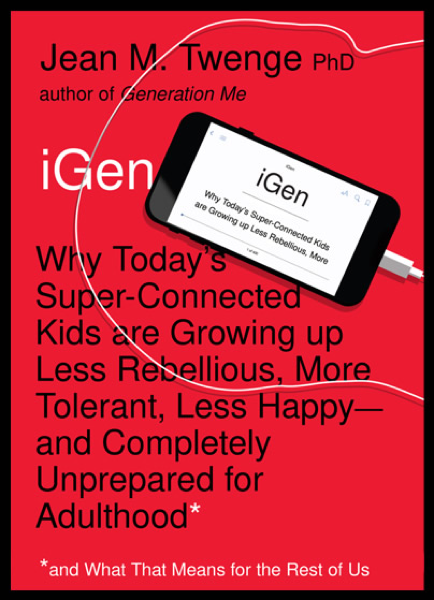
iGen: Why Today's Super-Connected Kids Are Growing Up Less Rebellious, More Tolerant, Less Happy--and Completely Unprepared for Adulthood--and What That Means for the Rest of Us
Twenge defined the iGen as those born between 1995 and 2012 (basically equivalent to Gen Z). They are the first generation to grow up with smartphones.
- Twenge's TedTalk on March 9, 2018 via YouTube (7'30") at Laguna Blanca School, Santa Barbara, CA
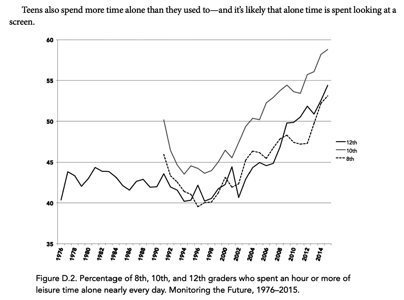
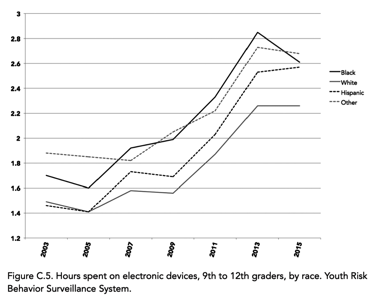
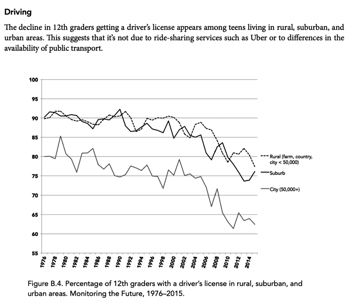
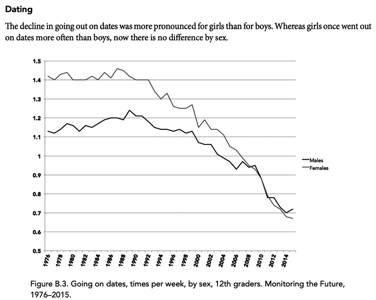
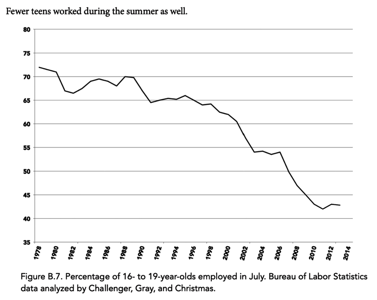
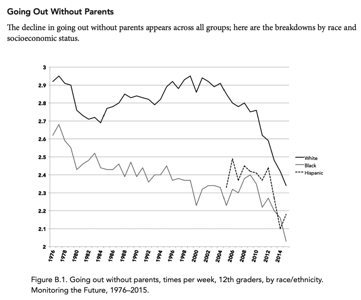
All graphs from Twenge (2017)
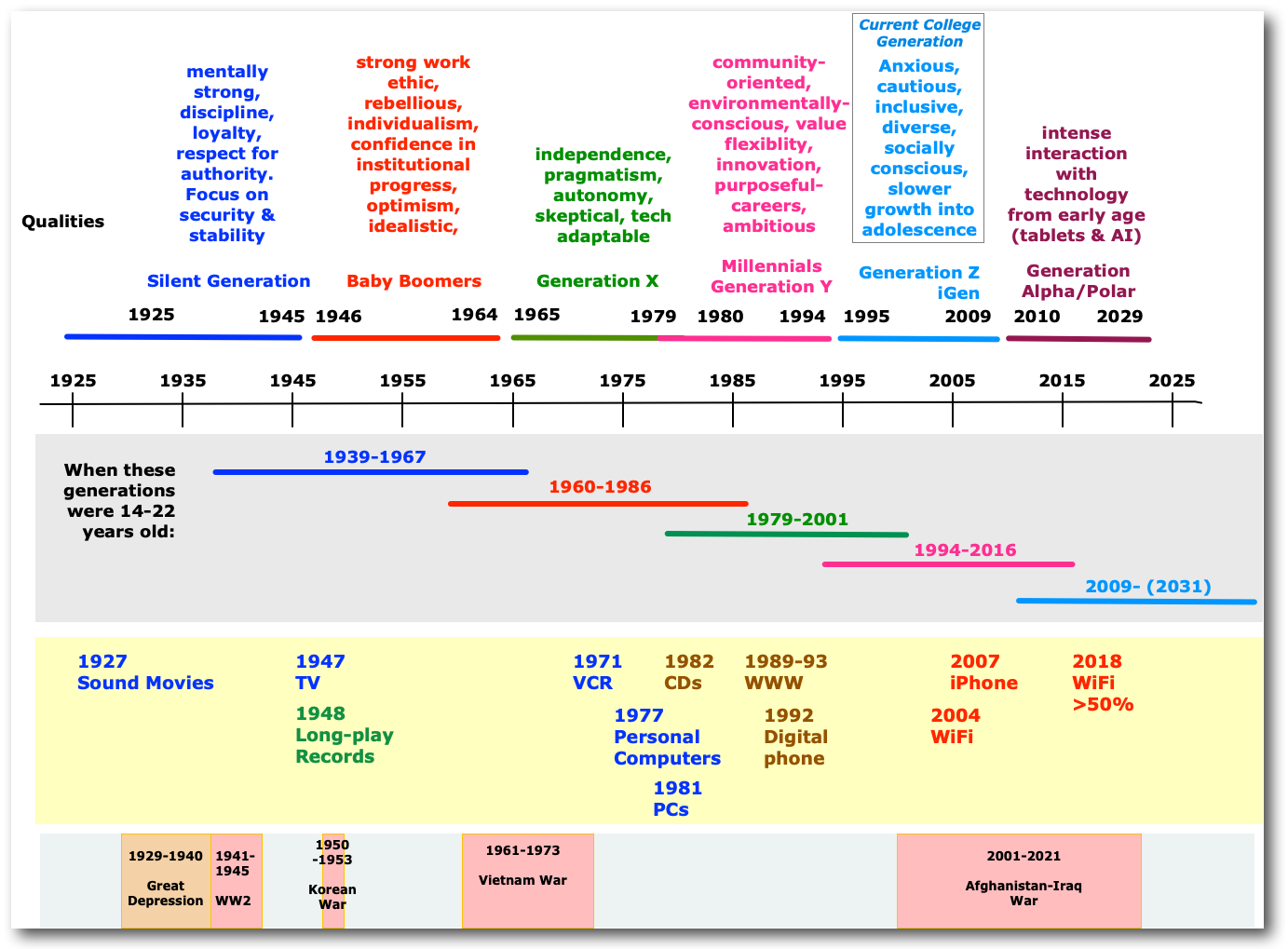
Qualities: Safer, more tolerant, and less rebellious, but face an unprecedented mental health crisis characterized by higher rates of loneliness, depression, and anxiety.
- Smartphone & Social Media Impact: The adoption of smartphones around 2012 correlates with a sharp rise in teen depression and reduced in-person socializing.
- Mental Health Crisis: Between 2011 and 2021, clinical depression among teens more than doubled. The suicide rate for 12-to-14-year-olds doubled since 2007, with, as noted on the TED website, similar, dramatic increases in anxiety and loneliness.
- Slower Life Development: iGen is growing up more slowly than previous generations, with fewer teens driving, dating, or working part-time jobs.
- Personality & Social Shifts: They are more individualistic, less interested in traditional, organised religion, and more focused on safety, which can leave them less prepared for the risks of adulthood.
Comments about Twenge's talk include some who disagree with her. For example:
@bumblerat1416 6 years ago
there is a difference between correlation and causation. personally, i feel that my phone (and the Internet in general) has helped me understand mental health, the LGBT community, politics, humor, and history more than school has. those who are already struggling with, let's say, depression, are already more likely to socially isolate themselves and go on their phone. resources for mental health (and any educational services) are more prominent than ever. although phones can cause differing sleep habits and other physical changes, phones aren't always the direct cause for depleting mental health.
@deepakadlar7927 3 years ago
you're saying that go to watch sunset and meet with friends all outdoor things
but my parents don't allow me and my siblings to go outside and here is no park or playground or even library so I can went and I am not rich so I can buy hardcopy books
so what can I do without my laptop and phone.
@franciscolopez7101 6 years ago
I agree that people waste too much time on their phones, but the way she presents some of her statistics is misleading. Look at the scale on some of her graphs, she has a tendancy to manipulate the scale to make small changes look big. The first graph she puts up is a good example of that (the scale only runs from 1.7 to 2.9).
She says the suicide rate for 12 to 14 year olds has doubled since 2007, but if you look at the scale on her graph you see that the suicide rate has gone from one in 100,000 to two in 100,000 for girls, and that the number for boys is the same as it was in 2000.
Generations: The Real Differences Between Gen Z, Millennials, Gen X, Boomers, and Silents―and What They Mean for America's Future
Thesis: Generations are primarily shaped by technology, leading to increased individualism, a "slow life strategy" (slower maturation), and distinct cultural attitudes
Generational Contexts
- Silent Generation: Experienced the Great Depression and World War II and, thus, valuing stability and safety.
- Baby Boomers: Came of age during a time of both immense social change (civil rights movement, feminism, protesting against the Vietnam War, etc.) and economic prosperity
- Generation X: Came of age during a rise in divorce rates and the dawn of the PC era when the first personal computers began to be sold widely (but before the arrival of the Internet)
- Millennials/Generation Y: The first generation to come of age with the internet (World Wide Web) and the rise of smartphones. Were adolescents and young adults during/after 9/11 and US involvement in Middle East wars.
- Generation Z/iGen: True “digital natives” who experienced a slower, more cautious adolescence, taking longer to start working or driving. Rise of social media.
- Generation Alpha/Polars: Shaped by early, intense interaction with technology, including tablets (iPads), social media (TikTok, etc.), and AI, from a very young age
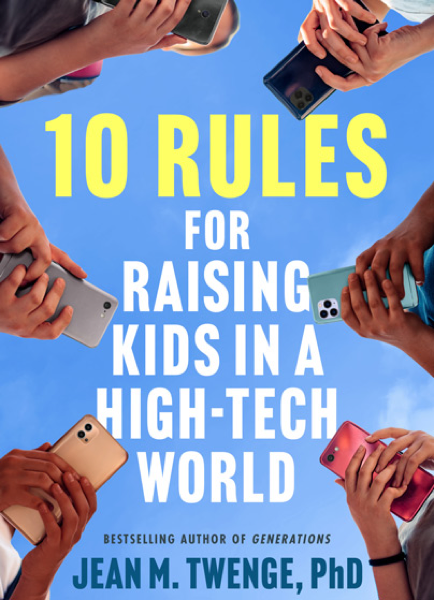
Ten Rules for Raising Kids in a High-Tech World
What are the 10 rules that Twenge recommends for parents? The are:
- You're in Charge: Parents must set boundaries and not let technology run the household.
- No Devices in the Bedroom Overnight: Keep devices out of bedrooms to prioritize sleep.
- No Social Media Until 16 (or later): Delay social media, as it is not developmentally appropriate for younger children.
- First Phones Should be Basic: Start with a simple phone for communication, not a smartphone.
- Smartphone with a Driver’s License: Delay the first smartphone until ages 16-17.
- Use Parental Controls: Implement technical restrictions.
- Create No-Phone Zones: Establish areas/times with no phone use, such as the dinner table.
- Give Real-World Freedom: Encourage in-person, offline activities.
- Beware of Tablets, Laptops, and Consoles: Monitor and limit all screen devices, not just phones.
- No Phones During School: Advocate for a phone-free school day.
Disagreement with Twenge:
Amy Orben (Cambridge University) & Andrew K. Przybylski (Oxford University)
The theses of both Jean Twenge and Jonathan Haidt about the negative effects of digital technology on adolescent mental health and well-being have been challenged by other social scientists. Perhaps the most vocal critics are two psychologists at Cambridge and Oxford Universities (UK), Amy Orben & Andrew Przybylski. In response to Twenge's 2017 iGen publication, they carried out their own set of analyses. The conclusion they reached is summarized in this Abstract:
The widespread use of digital technologies by young people has spurred speculation that their regular use negatively impacts psychological well-being. Current empirical evidence supporting this idea is largely based on secondary analyses of large-scale social datasets. Though these datasets provide a valuable resource for highly powered investigations, their many variables and observations are often explored with an analytical flexibility that marks small effects as statistically significant, thereby leading to potential false positives and conflicting results. Here we address these methodological challenges by applying specification curve analysis (SCA) across three large-scale social datasets (total n = 355,358) to rigorously examine correlational evidence for the effects of digital technology on adolescents. The association we find between digital technology use and adolescent well-being is negative but small, explaining at most 0.4% of the variation in well-being. Taking the broader context of the data into account suggests that these effects are too small to warrant policy change. (Orben & Przybylski, 2019; emphases added)
Orben's major claims involve the following (Anthony, 2020):
- Correlation vs. Causation: Orben argues that Twenge relies on correlative studies, which do not prove that smartphones cause mental health issues.
- Small Effect Sizes: Orben’s research, often with colleague Andrew Przybylski, found that the negative impact of technology is extremely small. She famously noted that, based on data, whether a teenager wears glasses is a stronger predictor of well-being than their social media use.
- "Old Wine in New Bottles": Orben has suggested that Twenge's arguments follow a historical pattern of blaming new technologies for social ills (similar to past panics over radio or television) and that Twenge previously labeled millennials as "miserable" and "narcissistic" before the iPhone existed. Note that Orben’s doctoral thesis examined the “moral panic” associated with radio broadcasts in the 1940s.
- Missing Other Factors: Orben contends that Twenge fails to account for other, more significant factors for rising teen distress, such as economic instability, school stress, or changing social norms that make teenagers more comfortable reporting mental health issues.
- "Goldilocks" Effect: Orben's analysis has suggested that moderate users of technology often have better mental health than non-users, contradicting the idea of a purely linear, negative relationship.
- Instead of a simple cause-and-effect relationship, Orben suggests that the link between technology and mental health is "complicated" and often bidirectional, where already struggling teens may use technology differently, rather than the technology itself causing the distress.
References
Anthony, A. (2020, February 1). Interview: Amy Orben: ‘To talk about smartphones affecting the brain is a slippery slope.’ The Guardian. https://www.theguardian.com/technology/2020/feb/01/amy-orben-psychology-smartphones-affecting-brain-social-media-teenagers-mental-health
Orben, A. & Przybylski, A. K. (2019). The association between adolescent well-being and digital technology use. Nature Human Behavior, 3, 173–182. https://doi.org/10.1038/s41562-018-0506-1
Twenge, J. (2017) Appendix A: Sources, methods, and separating cohorts and time periods. In iGen: Why today's super-connected kids are growing up less rebellious, more tolerant, less happy--and completely unprepared for adulthood--and what that means for the rest of us. New York: Atria Books. https://www.jeantwenge.com/wp-content/uploads/2017/08/igen-appendix.pdf
This page was first posted on 3/4/2026