PSY 355 Psychology
& Media in the Digital Age
This page was last modified on February 20, 2026
|
|
PSY 355 Psychology
& Media in the Digital Age
This page was last modified on February 20, 2026 |
Class 16: The Neuropsychology of Media • II The Automobile as Digital Device (Outline)
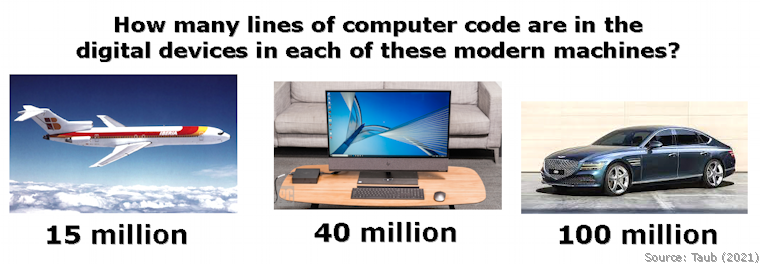
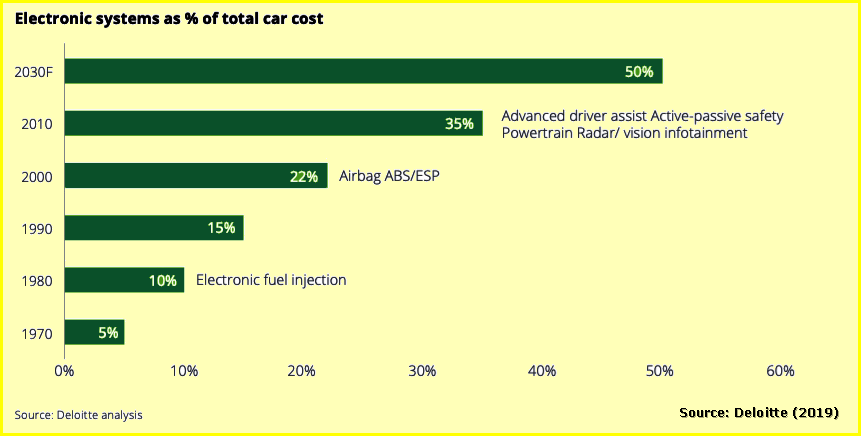
- The cost of new cars are increasingly the result of the installed electronics:
- Other Earlier Technologies
- 1st Car Radios (all AM) • 1930s
- 1st FM Radios • 1950s
- Transistors in the 1950s & 1960s reduce the price of radios
- 8-Track tape players (1965) and built-in cassette tape players by the 1970s
- CD players by mid-1980s
Distracted Driving: The Automobile as Media Setting
2026 Honda Civic • Best Affordable Compact Car (USNWR)
MSRP of $24,695 - $32,395- 7-Inch Color Touch-Screen with Apple CarPlay® and Android Auto™ Compatibility
- Bluetooth® streaming audio
- Steering-wheel-mounted audio & driving controls. All Civic steering wheels have two sets of controls. The left-hand set operates the audio system and 7-inch Driver Information Interface (DII). The Bluetooth® HandsFreeLink® and the navigation system voice-recognition button are on the left as well. The right-hand set operates the Lane Keeping Assist System11 (LKAS) Adaptive Cruise Control (ACC) with Low-Speed Follow
- Bose Premium Sound System
-All systems also provide Speed-Sensitive Volume Compensation (SVC); as the car speeds up and exterior noise increases, the audio system automatically raises the music’s volume, and then lowers it as the car slows down.
- Adaptive cruise control, lane departure warning, traffic sign recognition and automatic stop system.
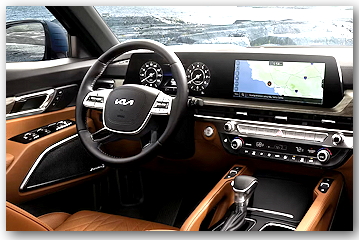
2025 Kia Telluride • Best Midsize SUV (USNWR)MSRP = $35,690-52,785- 12.3-inch Touchscreen Display w/ Navigation, Kia Connect & SiriusXM® Satellite Radio
- Rear-View Monitor w/ Dynamic Parking Guidance
- Apple CarPlay® & Android Auto™
- Bluetooth® Wireless Technology w/ Multi-Device Connectivity
- Wi-Fi Hotspot
- Smart Cruise Control w/ Stop & Go
- USB-C Fast Charging Ports, 5
- Rear seat entertainment (RSE) center:Two monitors and two remotes. Provides USB ports. New available APP's: Pinkfong (For Kids), News (CNN, Fox News), Games. RSE currently does not support Apple CarPlay or AirPlay. [Cost: an additional $1400]
sL2026 Mercedes-Maybach SL 680
Base Starting price: $226,500- 4.0-liter V8 biturbo engine with 577 hp and 590 lb-ft of torque
- 4MATIC+ fully variable all-wheel drive
- 0–60 mph in 4.0 seconds (est.)
- Top speed of 161 mph (electronically limited)
- 9G-TRONIC 9-speed automatic transmission
Infotainment and Connectivity. "The SL680 driver faces a reconfigurable 12.3-inch digital instrument display. The new Maybach roadster is outfitted with the same MBUX infotainment system as the AMG SL63. It works through an 11.9-inch portrait-style touchscreen display and features the "Hey Mercedes" virtual assistant. The system offers Apple CarPlay and Android Auto compatibility. The display's graphics are crisp, but the user interface is complex and takes some learning to get used to." [Car & Driver Magazine; https://www.caranddriver.com/mercedes-maybach/sl680]
The contemporary automobile (car, wagon, SUV) serves as a hybrid media form which provides
Navigation in Cars
- a means of transportation
- an "infotainment" or "in car entertainment" (ICE) media center with multiple entertainment components (CD, MP3 players, BluTooth, GPS navigation, DVD, game consoles, WiFi, multiple driving controls)
GPS = Global Positioning System which is "a space-based satellite navigation system that provides location & time information in all weather conditions, anywhere on or near the Earth where there is an unobstructed line of sight to four or more GPS satellites" {W}. It requires at least 24 satellites to be in orbit and there are currently (Jan 2026) 31 in orbit.
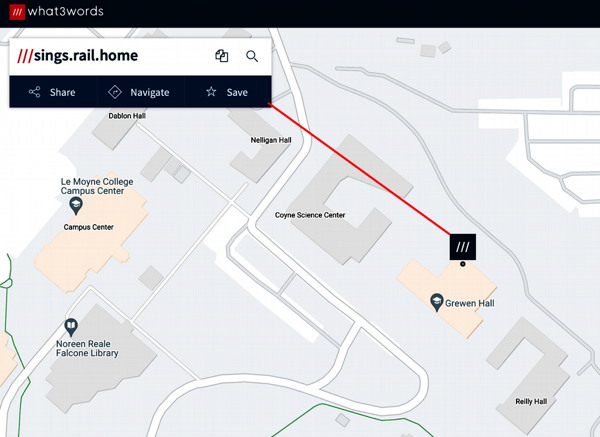
NEW: What3Words.com
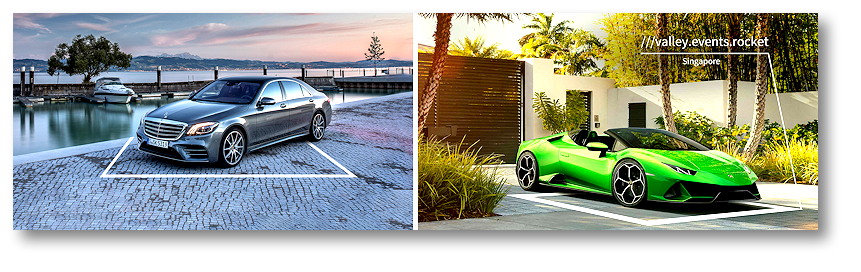
- What3words divides the world into a grid of 57 trillion 3-by-3-metre squares, each of which has a three-word address. The addresses are available in forty-seven languages. [Wikipedia]
- Each what3words language uses a list of 25,000 words (40,000 in English, as it covers sea as well as land). The lists are manually checked to remove homophones and offensive words. [Wikipedia]
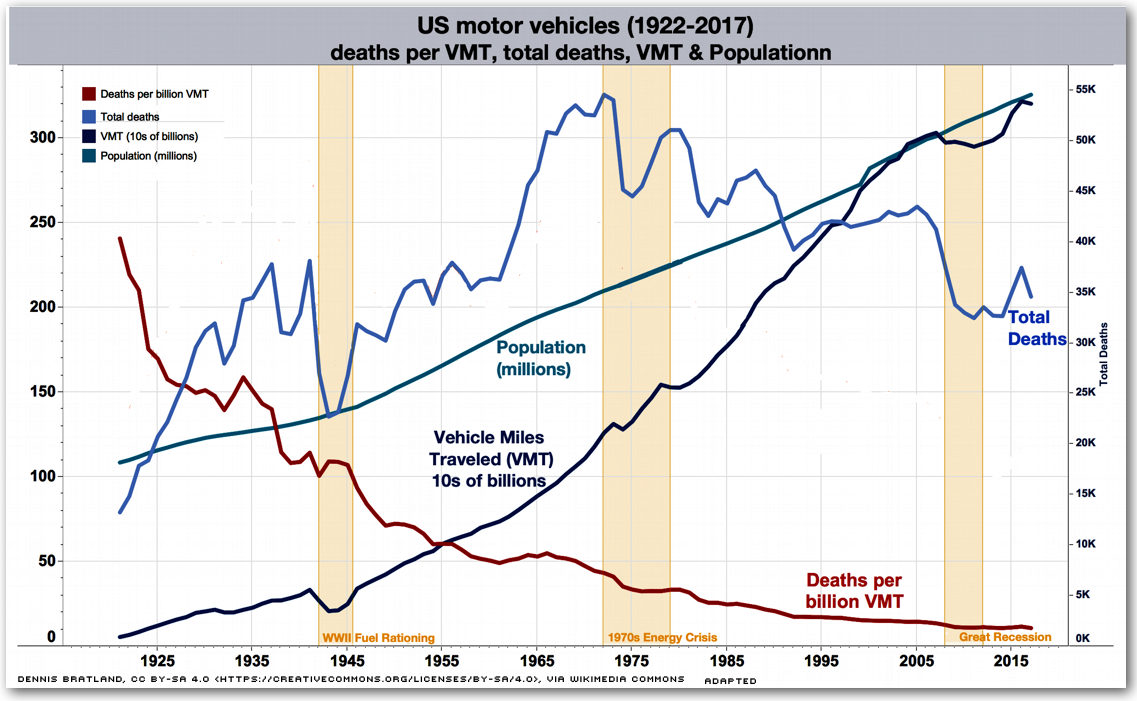
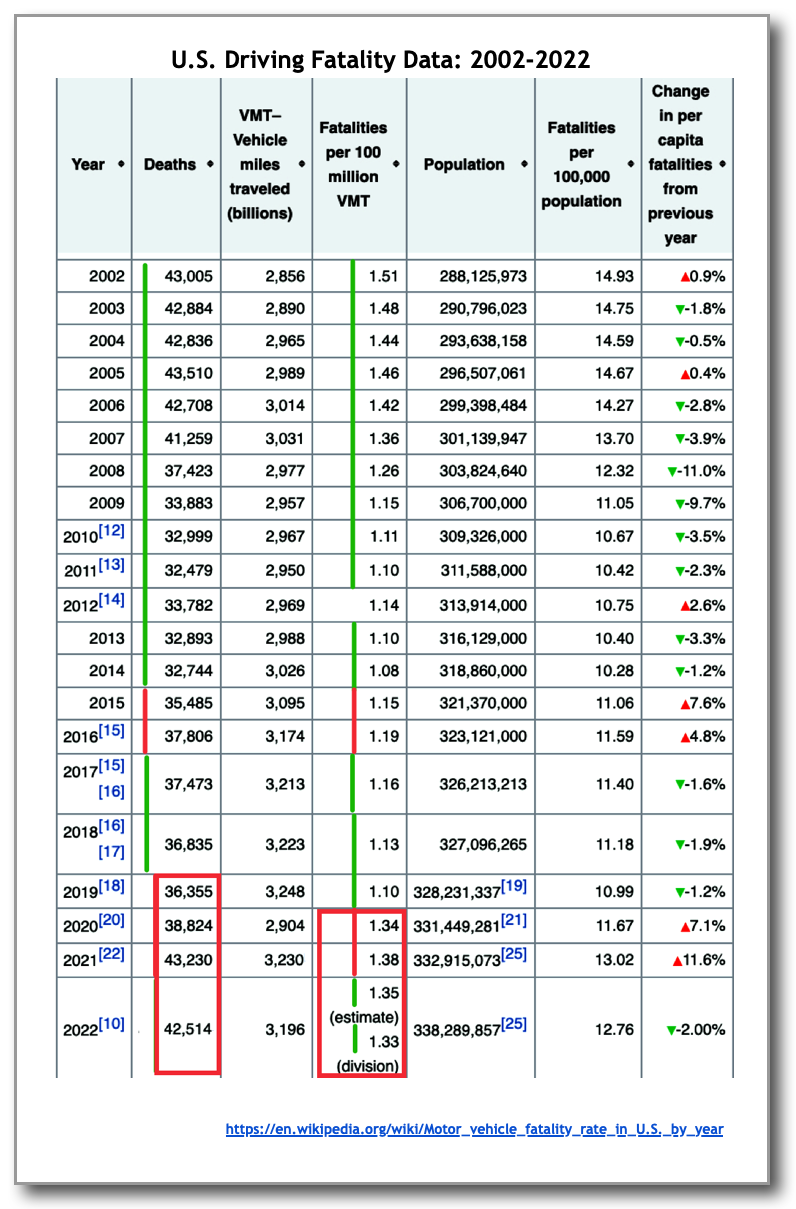
Traffic Fatalities & Improving Car Safety
- Death in 2019 (36,355) was down 1.2% from 2018 (N = 36,835) and 3.1% from 2017 (N = 37,473)
- BUT, death in 2021 (43,230) is an 18.9% increase over 2019
- Data for 2022 show a modest decrease in deaths (42,514) compared to 2021. But, the 2022 fatality rate per 100 million miles driven of 1.35 is 25% higher than it had been only 8 years earlier (2014 = 1.08).
Distracted Driving: Measuring the Effects
- Visual Processing Competition: Driver doesn't look at road in order to look at dash-board or other device
- Manual Interference: Driver takes hands off wheel in order to manipulate a device
- Cognitive Distraction: Driver withdraws attention from processing road- and safety-related information in order to accomplish another cognitive task.
- Each of these sources acts independently and can also interact with one another.
Past research has shown
- Drivers who are using a cell phone tend to experience "inattention blindness"
- Drivers engaged in a second cognitive task exhibit a form of "tunnel vision"
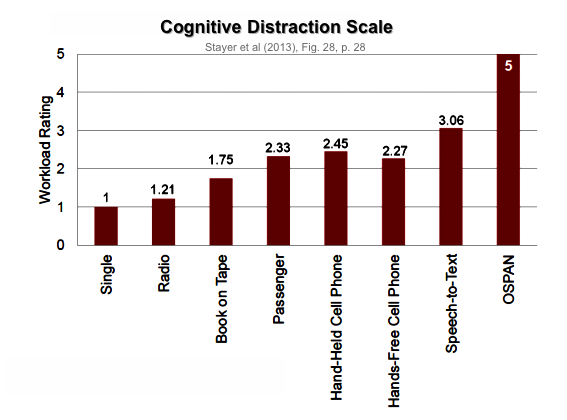
Experimental Set-up Tasks
1. None: Simple driving, no other task
2. Radio: Driving while listening to a radio
3. BookOnTape: Driving while listening to a book on tape
4. Passenger: Driving while holding 10 min. conversation with passenger
5. Handheld: Driving while holding 10 min. conversation on a hand-held cell phone
6. HandsFree: Driving while holding 10 min. conversation with a hands-free cell phone
7. Speech-Text: Driving while interacting with a speech-to-text interfaced email system
8. OSPAN: Driving while performing auditory version of the OSPAN mental processing tasks (math & memorization)
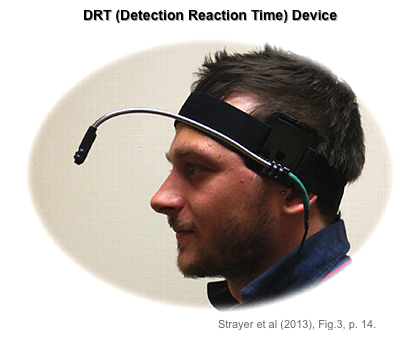
Experiment 1: Laboratory Control (Baseline)
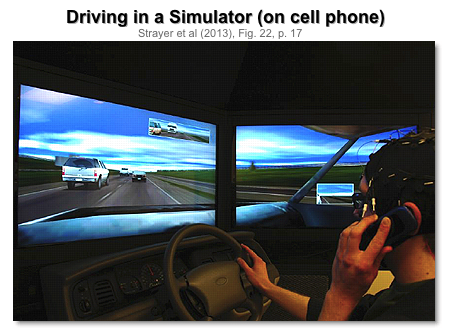
Experiment 2: Driving Simulator
Experiment 3: Instrumented Vehicle (in Real Life)
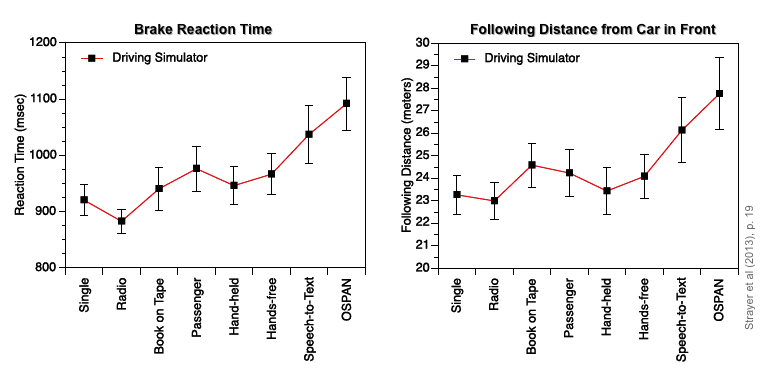
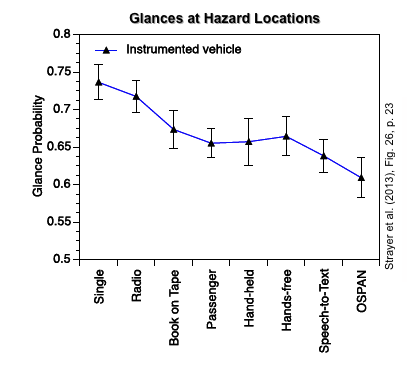
Some Results
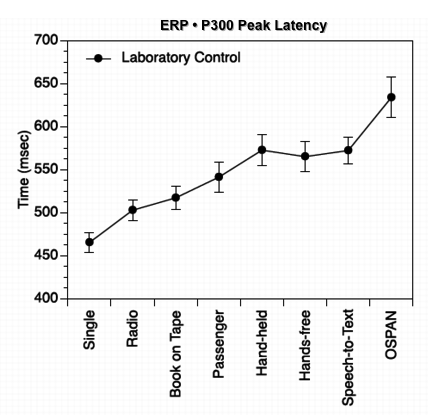
The first diagram shows the time delay for the event-related potential's P300 brain wave: a measure of cognitive difficulty and attentional loss.
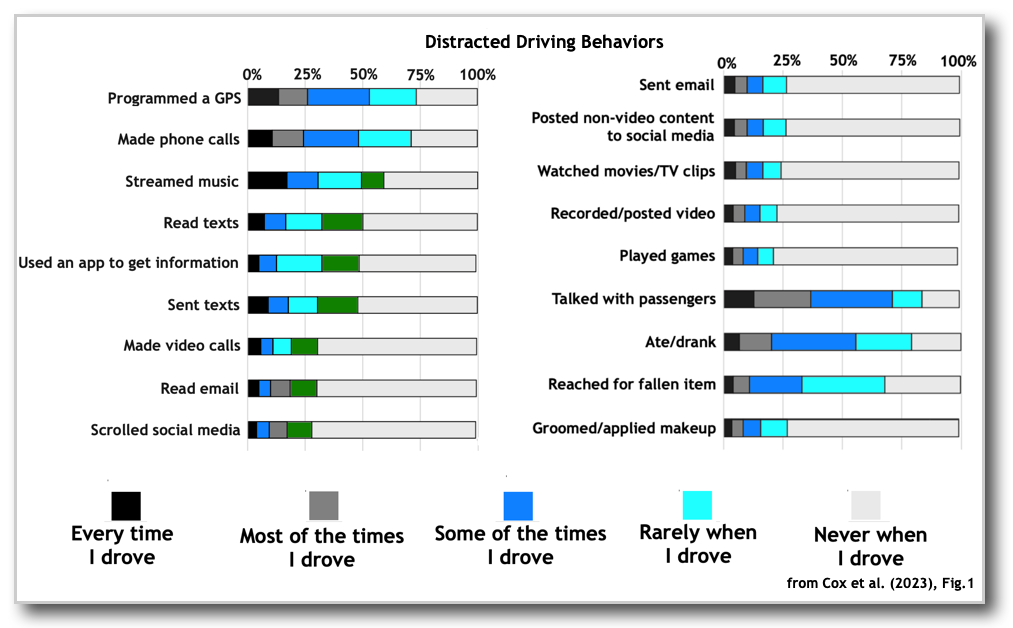
Cox et al. (2023) Distracted Driving Study
- Survey of 2,013 US licensed drivers over the age of 16.
- Asked these participants how often in the last 30 days did they do each of 18 different activities while driving which have been evaluated as distracting.
- They concluded: "Regular distracted driving is widespread with most behavior concentrated among drivers younger than age 50, though no age group or other demographic studied abstains."
Fill out the Cox et al. (2023) Distracted Driving Scale about your own behaviors.
Here is a summary of what Cox et al. (2023) found:
Some Other Research Findings
- Drivers who are 15–20 years of age constitute 6.4% of all drivers, but account for 10% of all motor vehicle deaths, and 14% of police-reported crashes
- "According to the results of a 2015 US national survey, the percentages of drivers ages 19–24 reporting engaging in the following behaviors at least once while driving in the past 30 days were as follows: 59% read a text/email, 45% typed/sent a text/email, and 77% talked on a cell phone, all increased from results of the same survey conducted in 2014 (AAA Foundation for Traffic Safety, 2015)"
- In the Youth Risk Survey, 2019, teenage drivers reported significant levels of texting or emailing while driving including 31% of 16-year-olds, 51% of 17-year-olds, and 60% of 18-year-olds.
- In a naturalistic study of 83 newly licensed teenage drivers in Virginia (53% female; average age 16.5 years), researchers installed video recording, accelerometer, & GPS tracking devices to observe/record driver behavior. They found 58% of the time that drivers were engaged in at least one task secondary to driving: (1) interacting with another passenger [20%], (2), talking/singing by self with no passenger [17%], (3) attending to external distractions outside car (12%); and (4) manual cellphone use (texting/dialing/browsing 5%).
ABC Nightline: Caught On Tape: Teen Drivers Moments Before a Crash
(AAA Foundation for Traffic Safety YouTube: 6'45" Mar, 2015)
==> We will watch this video and then break into smaller groups to discuss the following questions?
- What are the different sources of distraction you have noted in driving (beyond texting itself)
- What have you seen happening, e.g., with your parents, your friends, others?
- Is there anything that you think could convince people to drive in a safer way?
This page was first posted on 2/27/14
![[Cognitive workload et al.]](../psy355graphics/cogworkload.png)