PSY 355 Psychology &
Media in the Digital Age
This page was last modified on February 8, 2026
|
|
PSY 355 Psychology &
Media in the Digital Age
This page was last modified on February 8, 2026 |
Studying Psychology and Social Science:
Historical Stands & Methodological Approaches (Giles, 2003)
Early Approaches: 1930s-1960s
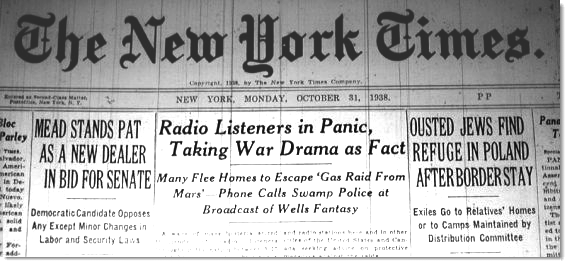
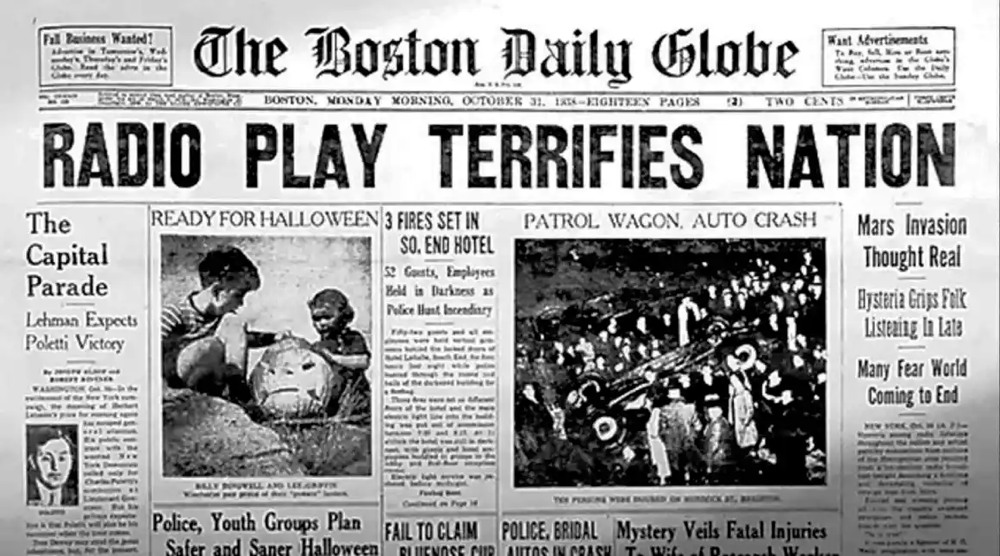
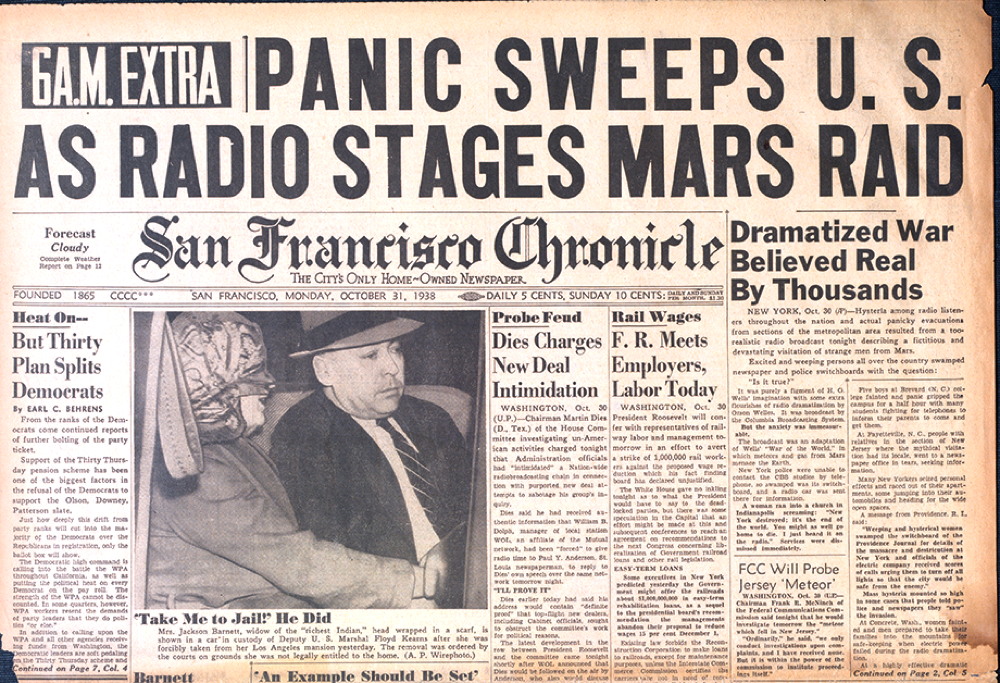
Orson Welles' famous "Mercury Theater of the Air": The great War of the Worlds {W} broadcast on Sunday night, October 30, 1938, at 8 pm on the CBS Radio Network
A. Marshall McLuhan (1911-1980) • A Founder of the Media Ecology Stand in Media Studies
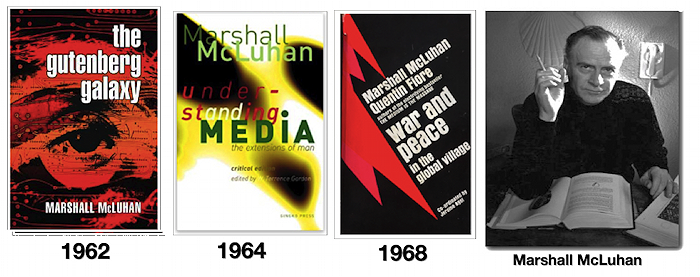
- "The Medium Is The Message"
- (1) We usually pay little attention to the way messages are sent and, therefore, don't realize how we have been changed by the medium,
- (*2) The medium itself creates powerful conditions that influence the nature of the received message. They affect how we think, feel, etc.
- "The Global Village" = Electronic media (especially television) creates a worldwide "village" in which Western media spreads Western cultural products around the globe. This has an effect of homogenizing cultures and reducing diversity. Yet, villages are often places where fighting and friction take place. Villages often tend toward tribalism and the rejection of others. NOTE: McLuhan died before the advent of the Internet & most digital technology.
B. Postmodern Era ("Late Modernity" or "Late capitalism")
Jean Baudrillard (1929-2007): French sociologist, cultural theorist, & philosopher
- In the 1980s, Baudrillard built upon the works of earlier media scholars including McLuhan and others. His major foray into media studies came with his 1981 book, Simulacra and Simulation.
- He claims that contemporary society has turned its back on actual reality and, using signs and symbols ("simulacra") communicated via media in general, made the human experience a simulation of reality.
- Before the Industrial Revolution, media representations generally reflected what was real and pointed toward the reality they copied. Think: paintings & sculptures as examples where the art tended to reflect what was actual in the world.
- After the Industrial Revolution, the proliferation of mass-produced copies of items--all of which were sold as commodities--reflected a breakdown in the distinction between representation and reality. For example, multiple individuals could boast of owning a copy of an artwork and claim that the copy was itself as much an artwork as the original paining or sculpture.
- In the postmodern world of "late capitalism" (late 20th century to today) the distinction between reality and representation breaks down much more fully. Media create completely artificial worlds ("simulacra") and sell these worlds as if they are actually real. A primary example of this notion lies in the 1955 creation of Disneyland, a topic we will look at in the weeks ahead. The "Main Street" of Disneyland supposedly is a model of a traditional small town's "main street," but, in fact, no traditional main street in America actually had the kinds of stores and other features found in Disneyland.
The Villages, Florida
- A retirement community for people over the age of 55 which was opened for residents in central Florida in 1992.
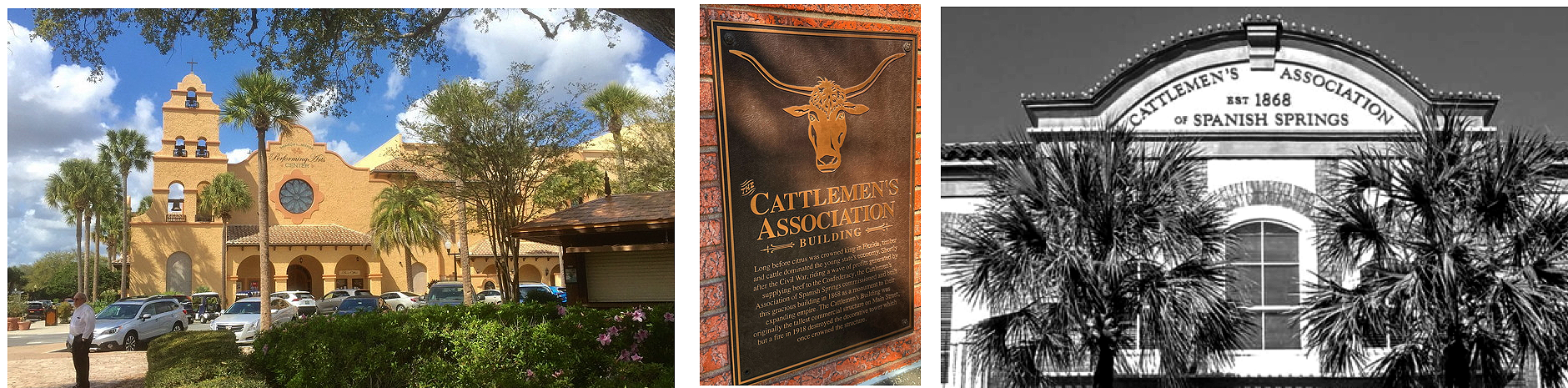
- In designing the three main "villages" of the community, the real estate developers decided that it would claim that the location extended back to the 19th and early 20th century. They created fictitious histories of buildings and supposed early residents of the area. For example, one area is known as "Spanish Springs" and the modern buildings constructed there were labelled as built many decades earlier. In the images below you see on the left a supposed early Spanish building, on the right the claim that a "Cattlemen's Association" had been established in 1868, and in the middle a plaque giving the made-up history of the Cattlemen's Association. In reality everything in the Villages was built in between the 1970s and early 1990s.
Major Approaches
to Researching the Psychology of Media since
1960
1. The "Effects" Tradition: 1960s+
- Media seen as having negative effects, e.g., violent media & violent behavior
- Uses experimental methods:
- Treatment group exposed to a dose of media & control group not similarly exposed = Independent variable
- Each group performs some activity (answers questionnaire, acts in some other way) = Dependent variable
- If groups differ in their behavior, it must have been because of the media dose they were exposed to
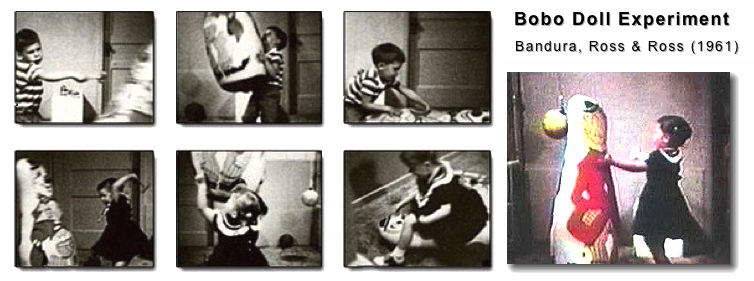
- Albert Bandura & the Bobo Doll experiment (explanation at Simply Psychology site)
- Cognitive psychologists look at how the thought processes such as memory & comprehension are affected
- Thinking/cognition & personality seen as moderating the effects of media exposure
2. Cultivation Research: 1970s+
- Media is a crucial element in a complex system of environmental & cultural forces.
George Gerbner (U. Penn, 1919-2005): How does a media-saturated society influence how the members of that society develop?
- Steady watching of TV on a long-term basis has a measurable (though small) impact upon how audience members view the world. Television has become in Western society more important and dominating than other forms of media.
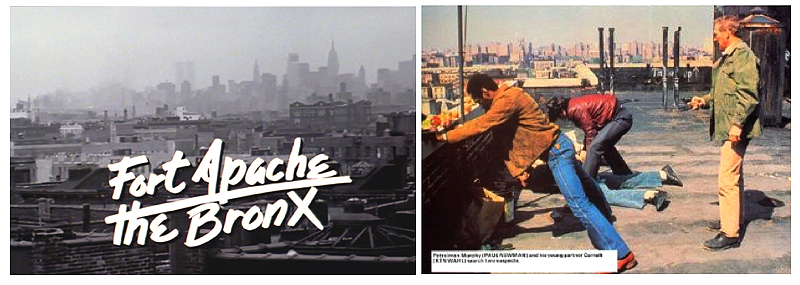
- Themes such as "fear" pervading the media: Fort Apache, The Bronx (1980) as a movie conveys how supposedly dangerous NYC is. Media can create a misconception of how dangerous the world is in reality.
- Often the victims of TV violence are minority and vulnerable people including the elderly, children, etc.
- The various streams of media across the world converge in a "mainstreaming" effect, i.e., values & cultures presented in media become commonplace all over the globe. US television programs & their impact on the developing world: US media are viewed everywhere
- Media acts to reinforce people's real life experiences = Resonance
3. Uses & Gratification Research: late 1970s+
- Focusing upon the psychological motives of individual media consumers: what are people looking for when they expose themselves to media
- Related to Abraham Maslow's famous hierarchy of motives (Note that recent research by Scott Barry Kaufman (2020) rejects that the hierarchy of needs diagram on the right actually represents what Maslow proposed. However, media researchers in the period from 1970 onward frequently used this hierarchy as a starting point for their own research.)
- Papachrissi & Rubin (2000): Why do we go online? Motives include
- Interpersonal utility (looking for online social interaction)
- Passing time
- Seeking information
- Convenience
- Entertainment
- Media dependency theory: In a media-saturated world, users come to depend on media for information &, indeed, on specific media outlets. How?
- Understanding ourselves by comparing ourselves to others
- Orientation of our behavior - how to act and how to interact
- Opportunities for play & recreation
4. Concern for the "Active" Audience
- Focus on larger audience groups (rather than the behavior or psychology of individuals)
- What is the role of "reality television"?
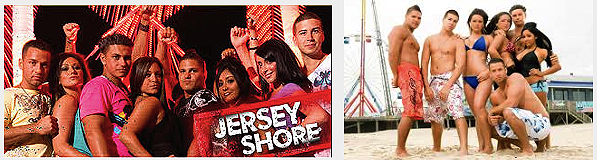
- The Jersey Shore
- The Amazing Race
- Keeping Up With the Kardashians
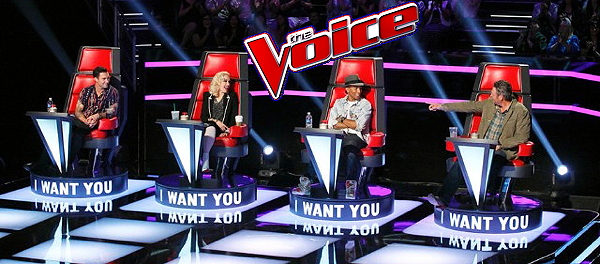
- The Voice
- Survivor
- What kinds of outlooks and "codes" do audiences bring to "read" the media they consume? In each of the responses noted below, the audience is doing something or responding in more than a completely passive way
- Some see the "dominant" (preferred) message intended by the producers
- Some modify the message according to personal experience of the audience itself
- Some treat the message with deep suspicion (opposing the message) and seejust propaganda
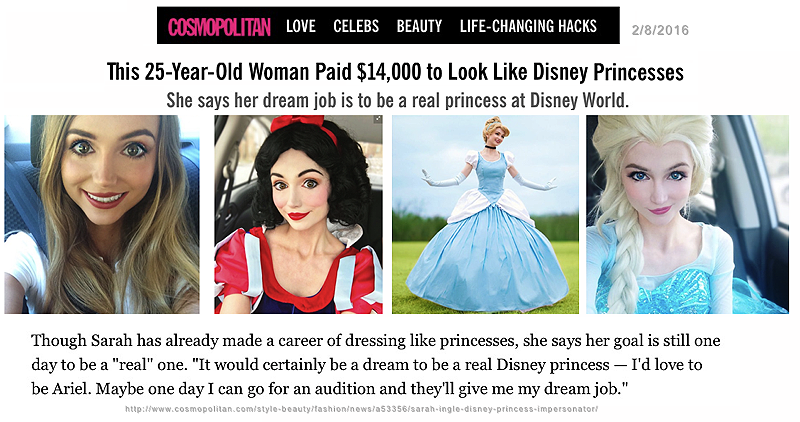
- Fandoms & Lifestyle (to be explored more broadly by Group 1)
- Media figures can be incorporated into the daily lives of their audiences
- Individuals may build their identities on media characters and situations
This page was first posted on 2/17/14