![[home]](../graphics/homep.gif)  |
PSY 340 Brain and Behavior Class 34: The Master and the Emissary: McGilchrist's Theory of Brain Lateralization (Outline) |
|
|
|
PSY 340 Brain and Behavior Class 34: The Master and the Emissary: McGilchrist's Theory of Brain Lateralization (Outline) |
|
Iain McGilchrist
- British psychiatrist and writer (b. 1953)
- Originally trained as a literature scholar
- Became a doctor and specialized in psychiatry
- Has done neuroimaging studies in the US
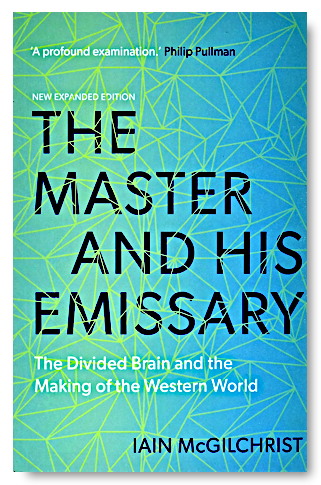
The Master and His Emissary: The Divided Brain and the Making of the Western World
• 2009
Two fine summaries of this book are found at
https://www.updevelopment.org/the-master-his-emissary-full-summary/
https://wisewords.blog/book-summaries/master-his-emissary-book-summary/
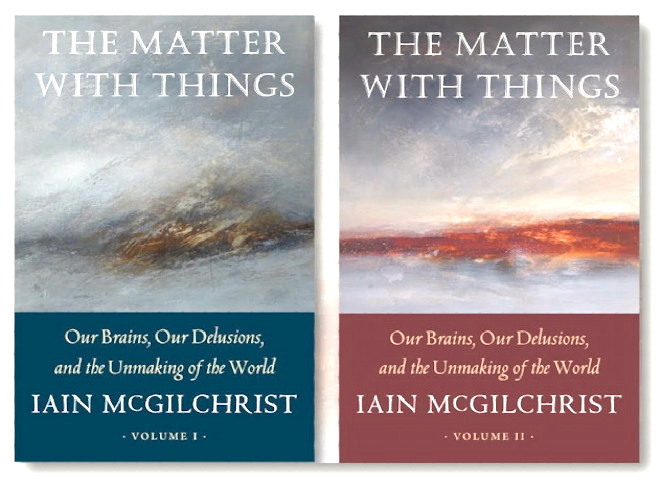
The Matter With Things: Our Brains, Our Delusions, and the Unmaking of the World
• 2021
A two-hour lecture by McGilchrist on this book at Ralston College in November 2021 can be found
at this YouTube link
Hemispheric Asymmetry
As we noted in the last class, the two hemispheres of the brain are asymmetrical (that is, have different physical characteristics).
- As McGilchrist (2021) points out: "The hemispheres differ in size, weight, shape, sulcal-gyral pattern (the convolutions on the cortical surface), neuronal number, cytoarchitecture (the structure at the cellular level), neuronal cell size, dendritic tree features, grey to white matter ratio, response to neuroendocrine hormones and degree of reliance on different neurotransmitters"
- The origin of these asymmetries is evolutionary and can be seen not only in humans but in other animals as well.
However, the differences go beyond just what is processed, but much more importantly how reality is perceived. Each hemisphere actually experiences the reality of the world in a different way.
- The lateralization of the brain's hemispheres allows each of them to specialize for different tasks and purposes.
- The RH is a world of "individual, changing, evolving, interconnected, implicit, incarnate, living beings within the context of the lived world"
- The LH is "dependant on denotative language and abstraction, yields clarity and power to manipulate things that are known, fixed, static, isolated, decontextualized, explicit, disembodied, general in nature, but ultimately lifeless"
According to McGilchrist who is using a metaphor, the "Master" is the right hemisphere (RH) while the "Emissary" is the left hemisphere (LH).
In a general sense, McGilchrist maintains that the
- RH is constantly scanning the overall environment for potential predators who might do harm or kill while
- the LH focuses more narrowly upon where prey might be found and captured before they can do damage.
Left Hemisphere ("The Emissary"
Right Hemisphere ("The Master")
Perspective
- Focused, narrow, and analytical; it breaks things into parts to categorize them.
- Sees the big picture, the context, and interconnectedness of the world around the person.
Attributes
- Values "re-presentation" (abstract models/uses maps of reality), power, and control.
- Values "presence" (experiencing things directly), empathy, and ambiguity.
Focus
- Attuned to the familiar, the static, and the mechanical.
- Attuned to the new, the living, and the individual.
The "Coup" of the Emissary
Iain McGilchrist's theory proposes that the two hemispheres of the brain do not just perform different tasks, but deliver two fundamentally different and competing versions of reality.
The core of the theory in his 2009 book (and expanded in his 2021 books) is that for a healthy mind and culture, the right hemisphere must be the "Master". Experience should begin in the right (global awareness), be sent to the left for analysis (technical processing), and then be returned to the right to be reintegrated into a meaningful whole.
McGilchrist argues that in the modern West, the Left Hemisphere (the Emissary) has effectively usurped the Right (the Master). Because the left brain deals with language and logic, it is very good at constructing self-consistent arguments that ignore its own limitations. This shift has led to a society that prizes:
- Bureaucracy over personal relationship.
- Utility and efficiency over beauty and wisdom.
- Abstract theory over lived, embodied experience.
Hemispheric Specializations
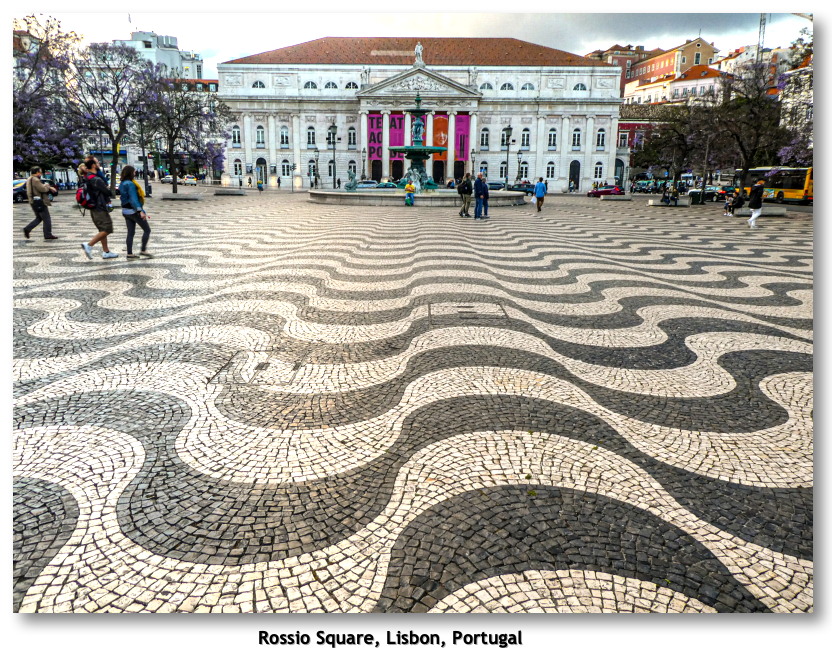
Take a look at this photograph. What immediately strikes you?
This is a picture of the north side of Rossio Square in Lisbon, Portugal
The National Theater of Dona (Queen) Maria II sits at the end of the square.
- Built in a neoclassical style from 1842 to 1846, the theater displays an elegant balance of stonework and windows.
- A baroque fountain in front of the theater mirrors the same type of fountain at the south end of the square. The fountain is situated so that it is exactly in the middle of the façade of the theater and, thus, creates even a greater sense of balance.
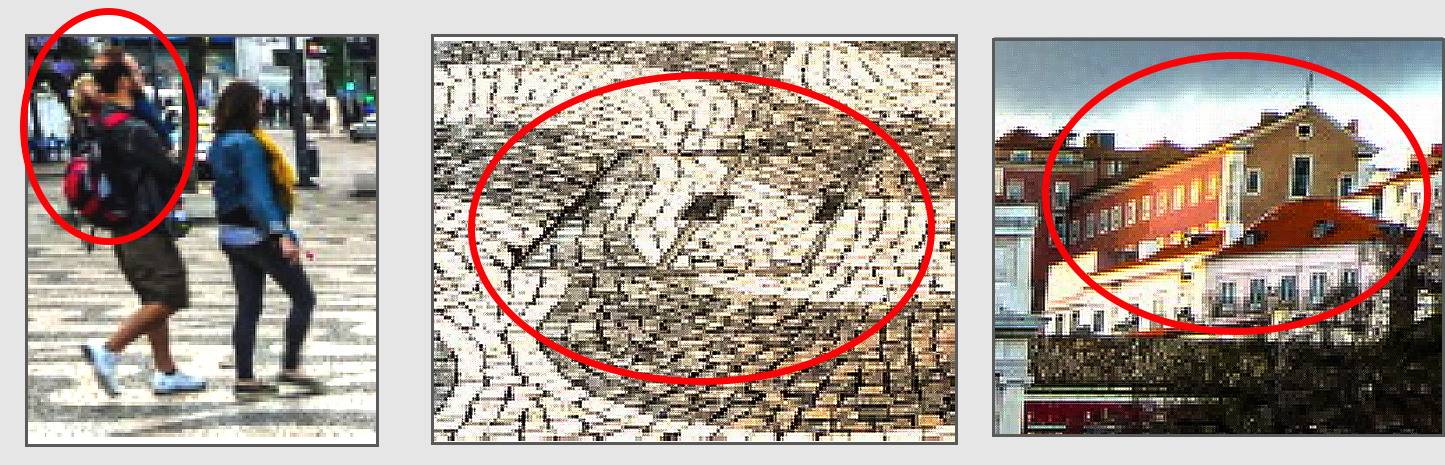
What do you not see usually when you first look at this picture?
- In the upper left/middle a couple is walking through the Square and the father is carrying a child
- In the pavement of the cobblestones, there seems to be a kind of sewer grating that allows workers to open up the ground and look below.
- In the extreme upper right of the photo there is a church on an overlooking hill.
- RH takes in the overall view and has an appreciation of the pattern while the LH actively scans the world to look for details.
Clinical Example of McGilchrist's Thesis
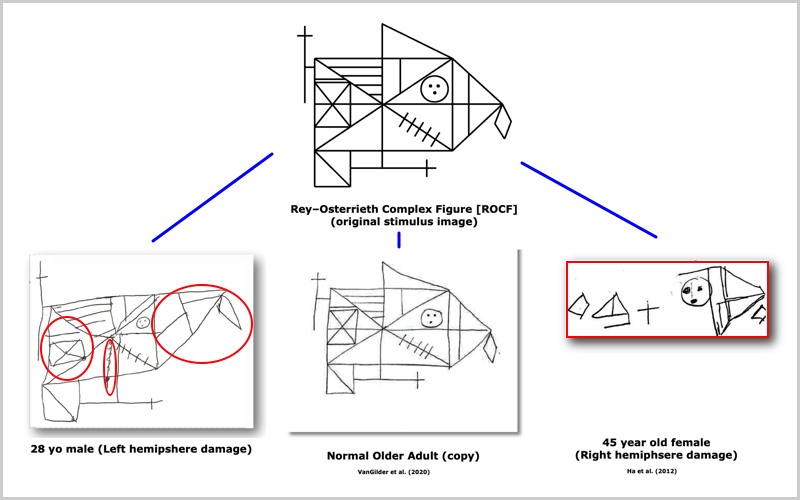
In the 1940s Swiss psychologist André Rey and his Belgian graduate assistant, Paul-Alexandre Osterrieth created the Rey-Osterrieth Complex Figure (ROCF)
Clinical neuropsychologists use the ROCF to test patients who have experienced brain damage by asking them to (1) copy the image; (2) reproduce the image from immediate recall; and (3) after 20 minutes, reproduce the image a third time (delayed recall)
How do these three images differ?
- In the middle an older adult without any neurological disorder has copied the ROCF quite accurately.
- On the left, this 28-year-old male who has experienced damage to his left hemisphere
- On the right, this 45-year-old woman with significant damage to her right hemisphere
What are the multiple ways in which the LH and RH are different?
Here is a list taken from McGilchrist (2021)
Keep in mind as you look at the differences above that each hemispheres has the ability both to excite and to inhibit the functioning of the other hemisphere.
Left
Right
Principally concerned with manipulation of the world
Principally concerned with understanding the world as a whole and how to relate to it
Deals preferentially with detail, the local, what is central and in the foreground, and easily grasped
Deals principally with the whole picture, including the periphery or background, and all that is not immediately graspable
Looks for and deals with what is familiar
Is on the lookout for, better at detecting and dealing with, whatever is new; an ‘anomaly detector’ (Ramachandran)
Aims to narrow things down to a certainty; comes to ‘either/or’ decisions or collapses ambiguity in favor of a definite outcome
Opens things up into possibility. The RH can sustain ambiguity and the holding together of information that appears to have contrary implications, without having to make an ‘either/or’ decision, and to collapse it, as the LH tends to do, in favor of one of them.
Tends to see things as isolated, discrete, fragmentary…as put together mechanically from pieces, and sees the parts
Tends to see the whole…a complex union
Tends toward fixity and stasis (inactivity, slowness)
Tends toward change and flow
Tends to see things as explicit and decontextualized, this, it largely fails to understand metaphor, myth, irony, tone of voice, jokes, humor more generally, and poetry, and tends to take things literally
Tends to see things as implicit and embedded in a context
Tendency to prefer the inanimate (non-living); machines and tools are coded in the LH
Tendency to prefer the animate (living) though the animate is coded in both LH & RH
If offered a story whose episodes are taken out of order, it tends to regroup them so as to classify similar episodes together rather than reconstruct them in the order that has human meaning.
Understands narrative (a story or tale…how it begins, unfolds, and comes to a conclusion
Tends to categorize by using the presence or absence of a particular feature as its major strategy
Tends to categorize by referring to unique exemplars, what Wittgenstein called “a family resemblance” approach - it sees the Gestalt (overall configuration)
Prefers more general categories
Prefers more fine-grained categories as one approaches more closely uniqueness. RH damage leads to a loss of the sense of uniqueness or the capacity to recognize individuals altogether
Tends to focus on parts (arms, legs, etc.) from which the body must be constructed.
Contains the ‘body image’ (= both a visual image and multimodal schema of the body as a whole). Superior at reading body language and emotion as expressed in the face or voice
Superior at fine analytic sequencing, a larger linguistic vocabulary, more complex syntax
Better at pragmatics (the ability to understand the overall importance of an utterance in context). Understanding prosody (the musical aspect of language including tone, inflection, etc.) depends largely on the RH
Understands simple rhythms
Understands music in general
Essential for “theory of mind” (= understanding another person’s point of view)
Empathy, emotional receptivity and expressivity are greater in the RH Sees things as they are “re-presented”, that is “present again” as already familiar abstractions or signs.
Better at seeing things as they are pre-conceptually, that is, fresh, unique, embodied, as they first present themselves to us Unreasonably optimistic and lacking insight into its own limitations
More realistic, but tending toward pessimism (= “a tendency to see the worst aspect of things or believe that the worst will happen; a lack of hope or confidence in the future”) Focusing upon where prey might be found and captured
Scanning the environment for potential predators
Final Comment. As noted earlir McGilchrist (2009) argues that, particularly in the West, the development of human culture has shaped human life in such a way that the functions of the left hemisphere have been prized and reinforced far more than the functions of the right hemisphere. In his argument, the "emissary" has gained control over the "master"
References
Ha, J.-W., Pyun, S.-B.., Hwang, Y. M. & Sim, H. (2012). Lateralization of cognitive functions in aphasia after right brain damage. Yonsei Medical Journal, 53(3), 486-494. https://doi.org/10.3349/ymj.2012.53.3.486
McGilchrist, I. (2009). The master and his emissary: The divided brain and the making of the Western world. New Haven, CT: Yale University Press.
McGilchrist, I. (2021). The matter with things: Our brains, our delusions and the unmaking of the world (p. 44). London, UK: Perspectiva Press.
UP Development (2022). Full summary - The Master and His Emissary, by Iain McGilchrist. https://www.updevelopment.org/the-master-his-emissary-full-summary/
VanGilder, I. L., Hooyman, A., … Schaefer, S. Y. (2020). Leave-one-out cross-validation and linear modeling of visuospatial memory to predict long- term motor skill retention in individuals with and without chronic stroke: A short report. BIOARXIV. https://www.biorxiv.org/content/10.1101/2020.10.14.330357v1.full.pdf
The first version of this page was posted April 15, 2022
![[Brain Image]](../graphics/head_space.gif)