![[home]](../graphics/homep.gif)

![[Brain Image]](../graphics/head_space.gif)
PSY 340 Brain and Behavior
Class 10: Structure of the Vertebrate Nervous System OUTLINE
|
|
PSY 340 Brain and Behavior Class 10: Structure of the Vertebrate Nervous System OUTLINE |
|
Structure of the Vertebrate Nervous System
A. Terminology to Describe the Nervous System
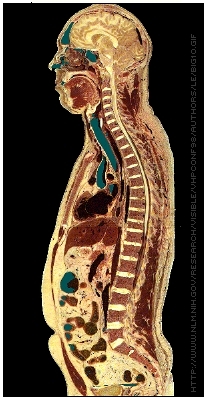
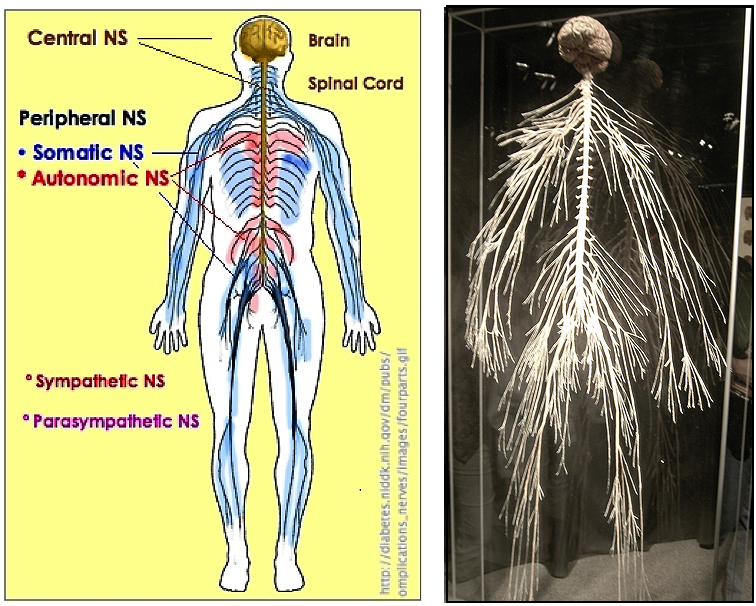
Central Nervous System (CNS)
- Brain
- Spinal Cord
Peripheral Nervous System (CNS)
Any nerve that does not belong to the CNS
- Somatic Nervous System (SNS)
- Autonomic Nervous System (ANS)
- Enteric Nervous System (ENS): Usually seen as part of ANS (more below)
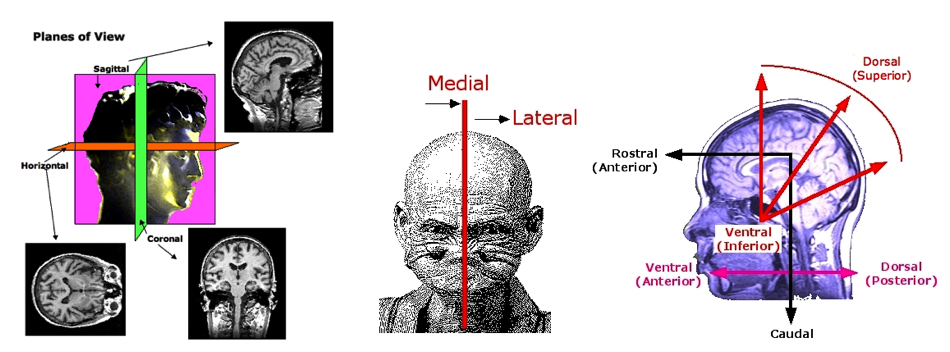
Directions in the Nervous System
Rostral from ROSTRUM - A bird's beak [& the prow of a ship]
Dorsal from DORSUM - An animal or person's back
Ventral from VENTER - The belly or abdomen
- A ventriloquist speaks from the belly.
Caudal from CAUDA - The tail of a horse
- The origin of the word, coward, since one sees the tail of the horse when a horse rider flees from battle
Superior is ABOVE while Inferior is BELOW
Proximal is NEAR while Distal is FARIpsilateral occurs on the same side
Contralateral occurs on the other side
- Lamina (laminae, pl.)
- Column
- Tract (Projection)
- Nucleus (nuclei, pl.)
- Ganglion (ganglia, pl.)
- Gyrus (gyri, pl.)
- Sulcus (sulci, pl.)
- Fissure
B. The Spinal Cord
Bell-Magendie law
- sensory information enters by way of the dorsal roots (in the back)
- motor information to the muscles and glands exits by way of the ventral roots (out the front)
- dorsal root ganglion (ganglia, plural)
- "Gray matter" in middle = cell bodies
- "White matter" surrounding = insulated axons
C. Autonomic Nervous System (ANS)
1. Sympathetic Nervous System
The sympathetic branch of the ANS prepares the body for action: fight or flight.
2. Parasympathetic Nervous System
The parasympathetic branch of the ANS helps to restore the body, build up energy & supplies needed in the future, and relax.
3. Drugs & the ANS
- Norepinepherine in PNS
- Acetylcholine [Ach] in SNS
- OTC drugs either suppress the PNS and/or stimulate the ANS leading to dry mouth & increased heart beating.
4. GI Tract and Enteric Nervous System (ENS)
- GI Tract
- ENS: lines walls of GI tract organs. Can function independent of CNS
- Food propulsion, nutrient handling, blood flow, immunological defense
- Microbiome (organisms in GI tract) can have effect upon behavior via signals to CNS
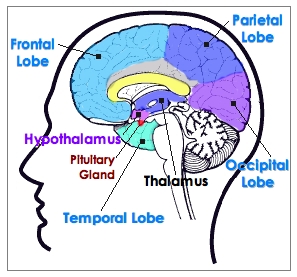
The Brain: Divisions
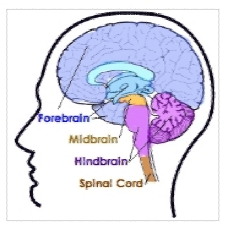
- Hindbrain
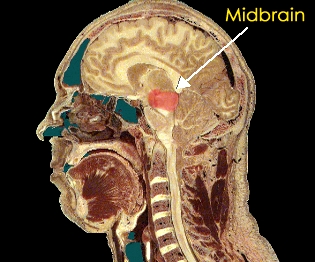
- Midbrain
- Forebrain
- Thalamus
- Hypothalamus & Pituitary Gland
- Basal Ganglia
- Basal Forebrain
- Hippocampus
- Cerebral Cortex (in the next class)
Hindbrain
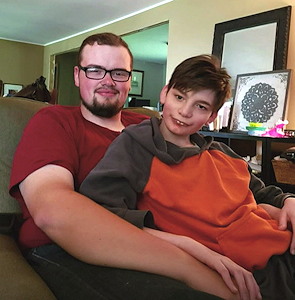
Chase with his older brother
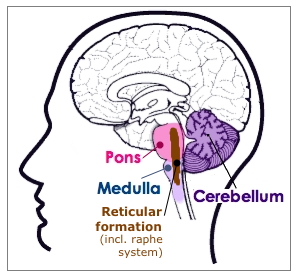
Medulla (oblongata) Pons (the "bridge")
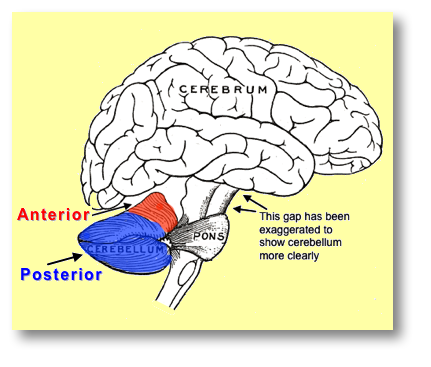
Cerebellum ("little cerebrum" or "little brain" with ca. 70 billion neurons)
- Ascending reticular formation/ascending reticular activating system
- Raphe system: major serotonin system
- Movement & balance
- Time-related behaviors (rhythm, drum playing)
- Simple learning & conditioning
- NEW: role in cognition, language, & affect (emotion)
- Anterior: motor & movement
- Posterior: cognition, language, affect
- Rapid model building of body interacting with the world around it
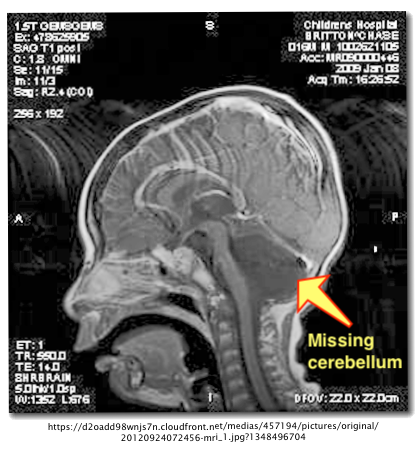
Agenesis of the Cerebellum [No or partial cerebellum at birth]
Chase Britton - Boy Without a Cerebellum (and Pons)
YouTube Video
Update (9/17/2013): Chase was 6 years old, had begun 1st grade (he was in kindergarten 2012-13), plays with his older brother Alex on his iPad, can count to 30, reads short words, and has a service lab/Great Dane dog named "Missa".
Update (8/14/14): Chase attended and met with Lady Antebellum at the Erie County Fair this year.
Updates in Dec. 2019 & May 2020. Chase was 12-13 years old, uses both a wheelchair and a special walker. He is also legally blind His father, David E. Britton, unfortunately died of stomach cancer at age 50 in May, 2020.
2026 No new updates on Chase who would now be 18-19 years old
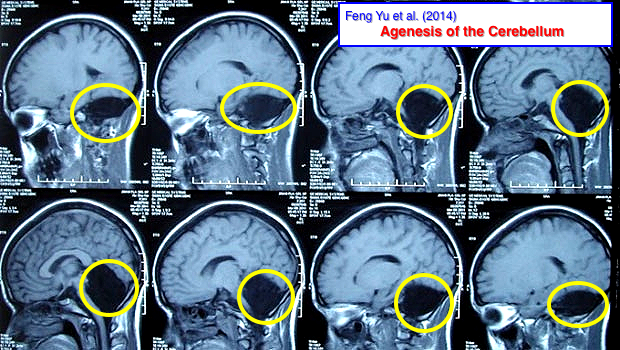
Chinese Woman, 24, found to lack cerebellum (2014)
Feng Yu et al. (2014)A 24-year-old woman in China went to the hospital complaining of a headache and was found to have been born without a cerebellum.
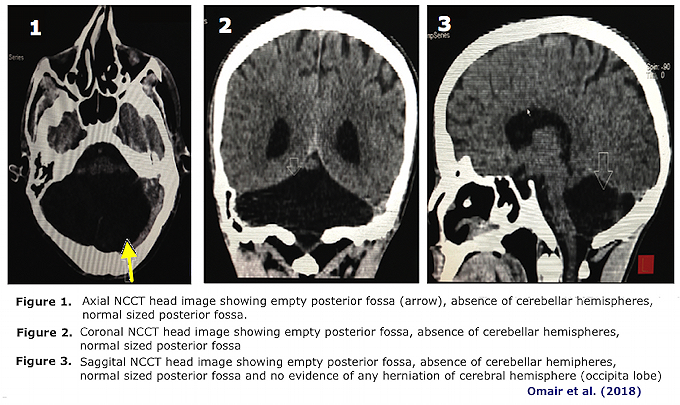
45-year-old man in India found to lack cerebellum (2018)
However, in all closely-studied cases of "agenesis of the cerebellum" there appears to be mild to serious levels of cognitive and/or motor impairment.
Midbrain
Tectum ("roof")
- Superior Colliculus ("upper little hill"): Visual orientation
- Inferior Colliculus ("lower little hill"): Auditory orientation
Tegmentum ("floor covering" or "rug")
- Ascending sensory & descending motor tracts pass through
- Regulation of movement (e.g., eyes)
- Pain modulation
Substantia Nigra ("dark substance")
- DA neurons required for smooth muscle control
- Loss = Parkinson's disease
Forebrain
Outer surface = Cortex (Latin = Bark of tree) [in next class]
Limbic System (linked set of structures beneath the cortex including olfactory bulb, hypothalamus, hippocampus, amygdala, & cingulate gyrus)
Thalamus ("antechamber")
Hypothalamus ("beneath the thalamus")
Pituitary Gland
Basal Ganglia
caudate nucleus, putamen, globus pallidus Basal Forebrain
- nucleus basilis
Hippocampus ("sea horse")
Lobes of the Cerebral Cortex - Covered in next class
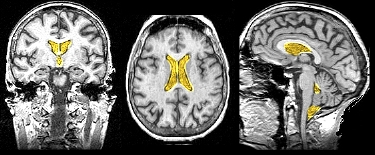
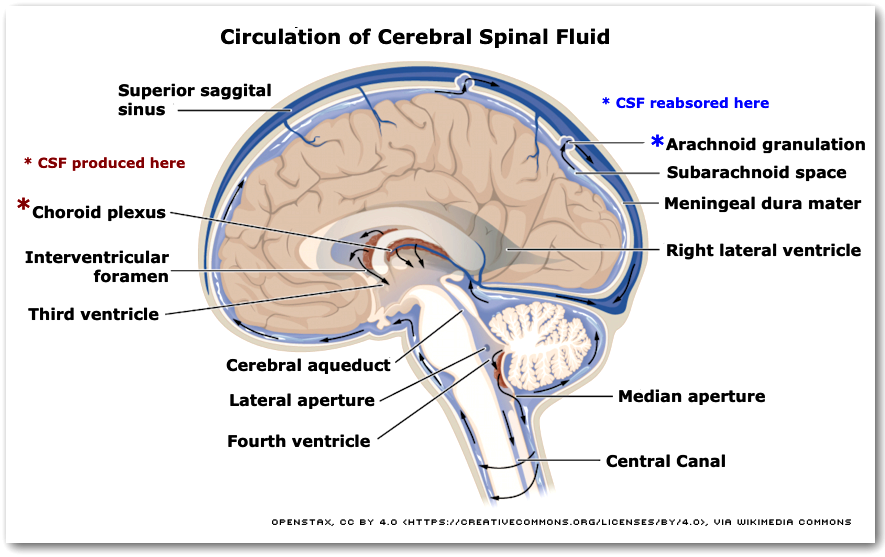
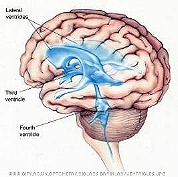
Ventricles and Cerebrospinal Fluid (CSF)
- cerebrospinal fluid [CSF]: Clear, colorless, watery substance akin to blood plasma
- shock absorber or cushion and support for the weight of the brain
- nutrition (vitamins, hormones)
- waste removal
- CSF is formed by the choroid plexus within the ventricles
- CSF flows throughout the ventricles and around the extracelluar space of the brain
- CSF is reabsorbed into the blood stream via the meninges
This page was first posted February 6, 2005
![[Comparison of Animal Brains]](../graphics/animal_brains_comparison.jpg)
![[Anterior/Posterior]](../graphics/orient3.jpg)
![[Chase Britton]](../photos/ChaseBritton2013.jpg)