Brain
- 3 pounds
- about 86 billion (+/- 8 billion) neurons
& about 84 billion glial cells
|
| B.
Hindbrain |
|
|
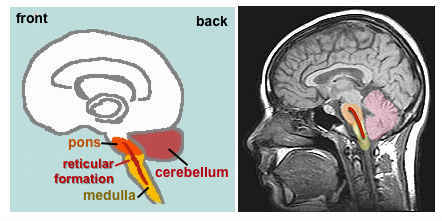 |
Cerebellum |
Large,
folded structure behind the brainstem.
- Coordination
of movement & balance
- Smooth
motion
- Fine
(intricate) motor skills
- Conditioned
learning
- NEW: role in
cognition (thinking), language, & affect
(emotion)
|
brainstem
= medulla & pons (below)
|
| Medulla |
- Regulation
of fundamental bodily activities such as breathing
and blood circulation. Major damage leads to death.
- Muscle
tone
- Reticular Formation: runs in middle of medulla, pons,
& into midbrain. Modulates breathing, pain,
& centrally involved in sleep, awakening &
arousal.
|
|
Pons
("The Bridge")
|
- Pathway
between the Cerebellum
and the Cerebrum (see below)
- Connects
the Cerebrum above with the brain
stem & the spinal cord below.
|
|
C. Midbrain
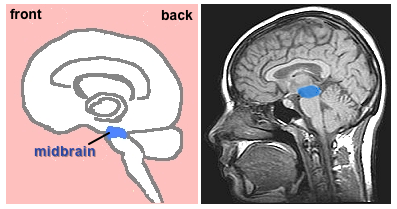 |
Segment
of top of the brain stem lying between the pons and
the forebrain.
- Sensitive
to orientation of individual in space; works with
voluntary muscle movement (e.g., moving head to
respond to someone's call or a strange sound;
tracking an object like a baseball to catch it)
- Dopamine-releasing
neurons project from the midbrain into the
forebrain. The gradual death of these neurons is
associated with the development of Parkinson's
Disease.
|
| D.
Forebrain |
|
|
| i. Thalamus |
- Relay
station for all incoming sensory information
(vision, hearing, touch, etc.) except for smell.
Information is passed on to cerebrum.
- Beginning
of the integration of this information.
|
| ii. Hypothalamus |
- Regulation
of basic bodily needs & functions;
maintains body's biological homeostasis (balance),
e.g, temperature, heart rate, blood pressure
- Control
of the autonomic nervous system: fighting vs.
relaxation.
- Basic
biological drives: feeding, thirst, sex
- Sends
various signals to the pituitary gland to release
hormones
|
|
iii. Limbic
System
![[Limbic
System]](../psy101graphics/limbic.jpg)
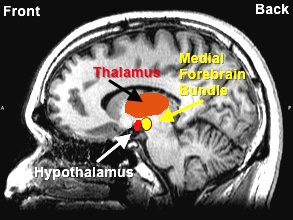
|
- A
loose network of structures which, together, appear
to be involved in the regulation and expression
of emotion and pleasure.
|
|
Hippocampus
- Human
memory processes. Long-term storage (consolidation)
of memories. We learned this from Patient H.M.
Amygala
- Evaluation
of the environment vis-a-vis emotion
- Particularly
involved in fear and anger responses
Medial Forebrain
Bundle (part of limbic system & passing
through the hypothalamus)
- Olds
& Milner (1954) discovery of self-stimulation
centers in rats' brains = "pleasure centers"
- DA-rich
neurons which, when stimulated, result in
pleasure/reward
|
| iv.
Cerebrum |
The largest and most complex part of the
human brain. |
![[Cortex Top View]](../psy101graphics/redcortexsuperior.jpg)
![[Cortex Bottom View]](../psy101graphics/redcortexinferior.jpg) |
Cerebral Cortex =
The
outer layer of the cerebrum. Deeply folded and
compacted
Cerebral Hemispheres.
Deep below the outer cortex, the two hemispheres are
connected by a thick bundle of fibers called the corpus
callosum.
![[Cerebrum]](../psy101graphics/cerebrum.png)
|
|
Lobes of
the Brain
![[Lobes of the
Brain]](../psy101graphics/lobes.jpg)
|
Frontal Lobe |
- Primary
motor cortex: initiation of movement (pink color in
diagram)
- Prefrontal
cortex: area in front of motor cortex (deep red in
diagram)
- Executive
functions: Goal planning, making decisions,
considering context
|
| Parietal Lobe |
- Primary
processing area for sense of touch and the other
somatosensory senses (temperature, pressure,
proprioception, etc; darker blue in diagram.)
- Processes
the spatial aspects of behavior (e.g., where the
body is located in space; lighter blue in diagram)
|
| Temporal Lobe |
- Primary
auditory processing area
- Comprehension
of spoken language
- Processes
visual data to recognize faces, objects, and what
they are called
|
| Occipital Lobe |
- Primary
visual processing area
|
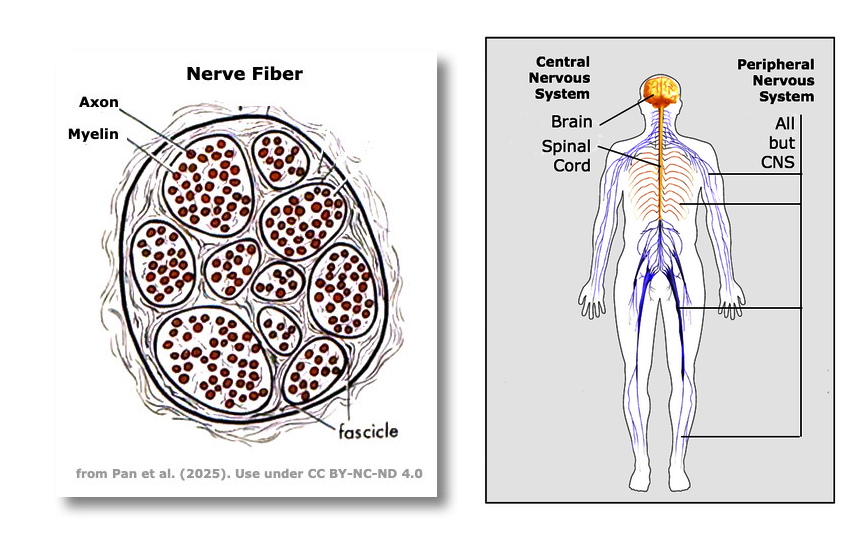 1. Organization of the Nervous System
 B. The Central Nervous System (CNS)
 ![[Cat
Scan Hemorrhage]](../psy101graphics/catscan1319_04.jpg)
![[Cat
Scan Tumor]](../psy101graphics/catscan1319_19.jpg)
![[MRI
Image Tumor]](../psy101graphics/mriscan1319_25.jpg)
![[Transcranial Magnetic Stimulation]](../psy101graphics/tms.jpg)
![[Paul Broca]](../psy101graphics/broca.jpg)
![[Tan's Brain]](../psy101graphics/tan.jpg)
![[Broca &
Wernicke's Areas]](../psy101graphics/aphasias.jpg)
![[Paul
Wernicke]](../psy101graphics/wernicke.jpg) Wernicke
Wernicke![[Roger
Sperry]](../psy101graphics/sperry.jpg)
![[Split
Brain Research Model]](../psy101graphics/splitbrain.jpg) Effects
of "
Effects
of "
