![[Home]](../psy101graphics/homep.gif) Nov. 27, 2025 |
PSY 101
![[Psychology Images]](../psy101graphics/intro_25.jpg) Class 39:
Psychological Disorders III: Schizophrenic Disorders
& Autism Spectrum Disorders (Outline) Class 39:
Psychological Disorders III: Schizophrenic Disorders
& Autism Spectrum Disorders (Outline) |
|
Nov. 27, 2025 |
PSY 101
Class 39:
Psychological Disorders III: Schizophrenic Disorders
& Autism Spectrum Disorders (Outline) |
|
Schizophrenia Spectrum and Other Psychotic Disorders
(DSM-5-TR)Schizophrenia (SCZ)
It DOES NOT mean that there are several people inside one person.
= class of disorders marked by delusions, hallucinations, disorganized speech, and deterioration in adaptive behaviors
Prevalence: Usual figure = 1% (to 1.5%) of the population (i.e., 3 to 4 million people in the USA)
- Rate is probably getting lower in recent years (0.6% to 1%)
Symptoms of Schizophrenia
Irrational Thinking
- Delusions
- Loosening of Associations
Deterioration of Adaptive Behavior
Distorted Perceptions
- Hallucinations
- Most frequent hallucinations are auditory
- Though the central character in "A Beautiful Mind" (2001) is shown with visual hallucinations, the real person of the story (Prof. John Nash) had auditory hallucinations.
Disturbed Emotions
- Inappropriate emotions
- Blunted or flat emotions
Subtypes (No longer used in the DSM-5/5-TR)
Paranoid
Catatonic
- Marked by significant motor disturbances
Disorganized
- Marked deterioration in adaptive behavior
- = social relationships, work, care of self/hygiene/health
Undifferentiated
| Negative Symptoms
= behavioral deficits Do not tend to respond to medication; somewhat worse prognosis |
Positive Symptoms = behavioral excesses Tend to respond to anti-psychotic medications; somewhat better prognosis |
 |
|
|
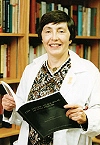
Nancy Andreason, MD
|
Course and Outcome
- 75% by 30 years old
- Three courses:
- Complete recovery (~20% => 50% with excellent treatment)
- Partial remission with relapses
- Chronic deteriorating illness (ca. 25%)
Etiology (Causes)
1. Genetic Vulnerability
2. Neurochemical Abnormalities
• DA (+ ? Serotonin x Glutamate)
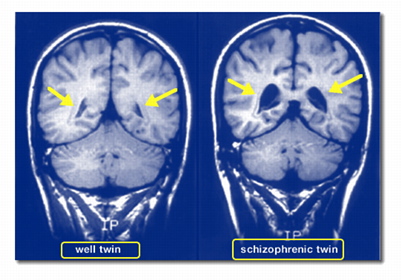
3. Structural Abnormalities in the Brain
4. Neurodevelopmental Hypothesis
5. Expressed Emotion
6. Stress
Autism Spectrum Disorders (ASD, 2018)
YouTube: Inside The Autism Spectrum (2015, 3'41")
from Autism Speaks
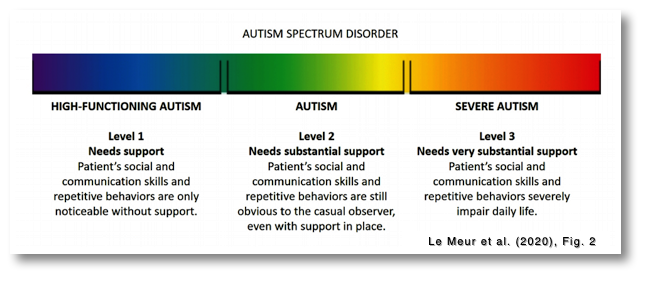
Autism Spectrum Disorders (ASDs) represent a range of developmental disorders (from mild to severe) in which individuals show
- significant impairment in social interaction and communication and
- severely restricted interests and activities, often performed repetitively
- usually seen by age 3.
Symptoms
Difficulties in Social Communication and Social Interaction
● Making little or inconsistent eye contact
● Speech is compromised (1/3 never develop speech
● Bonds with parents or peer relationships may be weak or absent
● Not responding or being slow to respond to one’s name or other verbal bids for attention
● Having difficulties with the back and forth of conversation
● Often talking at length about a subject of interest without considering social cues or conversational give-and-take
● Having trouble understanding another person’s point of view or being unable to predict or understand other people’s actions
● Difficulties adjusting behavior to different social situations
● Difficulties sharing in imaginative play or in making friends
Restrictive or Repetitive Behaviors
● Repeating certain behaviors or having unusual behaviors, such as repeating words or phrases (a behavior called echolalia)
● Having a lasting intense interest in specific topics, such as numbers, details, or facts
● Showing overly focused interests, such as with moving objects or with parts of objects
● Becoming upset by slight changes in a routine and having difficulty with transitions
● Some ASD children engage in self-harming behaviors such as banging their heads against objectsSensory Differences
● Being more sensitive or less sensitive than other people to sensory input, such as light, sound, clothing, or temperature
- 50-55% experience intellectual deficiencies
Strengths
- Learning things in detail and remembering information for long periods of time
- Doing well in certain school subjects such as math, science, music, or art
- Being strong visual and auditory learners
Prevalence
- Earlier estimates: less than 1%, i.e., 1 in every 150 children
- 2020 Estimate: at least 1 in 36 children in the U.S.
- An estimated 2.21% of the adult population over 18 years have autism
- Why has the prevalence of autism so dramatically increased?
- There is no scientific evidence linking autism to childhood vaccinations.
- The criteria for ASD has been expanded to include a larger range of disorders, i.e., individuals may be diagnosed on the spectrum with much milder forms of autism than originally described back in the 1940s. Thus, our understanding of autism has changed.
- Furthermore, there has been "Increased awareness of autism and declining stigma among teachers, health professionals and the broader public alongside increased availability of diagnostic and support services"
- Males = 80% of ASD diagnoses (Females may be under-counted)
Etiology
- Biological evidence
- Possible proliferation of neural cells soon after birth
- Significant genetic component (100 genes associated with ASD)
- Other possible causes include
- Advanced parental age
- Prenatal exposure to air pollution or certain pesticides
- Maternal obesity, diabetes or immune system disorders
- Extreme prematurity or very low birth weight
- Birth complications leading to periods of oxygen deprivation to the baby’s brain
This page was originally posted on 11/24/03