![[Home]](../psy101graphics/homep.gif) Nov 28, 2025 |
PSY 101
![[Psychology Images]](../psy101graphics/intro_25.jpg) Class
39: Psychological Disorders III: Schizophrenic
Disorders & Autism Spectrum Disorders Class
39: Psychological Disorders III: Schizophrenic
Disorders & Autism Spectrum Disorders |
|
Nov 28, 2025 |
PSY 101
Class
39: Psychological Disorders III: Schizophrenic
Disorders & Autism Spectrum Disorders |
|
Schizophrenia Spectrum and Other Psychotic Disorders
(DSM-5-TR)
A range of psychiatric disorders are included in the "schizophrenia spectrum."
Schizophrenia (SCZ) literally means "split" ("schizo-") + "mind" ("phrenia). However, the split was originally thought to be between the thinking and the feelings of the person.
It DOES NOT mean that there are several people inside one person. That is a condition called "Dissociative Identity Disorder" (formerly, Multiple Personality Disorder).
= A class of disorders marked by delusions, hallucinations, disorganized speech, and deterioration in adaptive behaviors
- Prevalence: Usual figure = 1% (to 1.5%) of the population (i.e. 3-4 million people in the USA); it is probably getting lower in recent years and would now be estimated at 0.6% to 1.0% of the population.
Symptoms of Schizophrenia
> Irrational Thinking
- Delusions: false beliefs which are clearly out of touch with reality
- for example: Delusions of Grandeur: "I am Jesus Christ" "I am God"
- Loosening of Associations: the train of thought of an individual is chaotic and does not make sense.
- for example: "I was going down to the store because it is October and the people near the street didn't tell me what was happening since I don't like to walk too fast. So, after the time when it was happening I decided that no one knew who I was and needed to buy some kind of bicycle or other type of train." (That paragraph doesn't make sense, but is an example of dissociated speech.)
> Deterioration of Adaptive Behavior
- Quality of functioning (a) in social relationships, (b) at work, or (c) in taking care of personal needs including health may become distinctly poorer
> Distorted Perceptions
- Hallucinations: sensory perceptions that occur in the absence of a real external stimulus or are gross distortions of perceptual input
- Most frequent hallucinations are auditory, especially hearing voices which are often insulting, commenting upon the person's behavior or telling the person what to do.
- In the 2001 movie "A Beautiful Mind" John Nash, the character played by Russell Crowe, is schizophrenic and he hallucinates visually, that is, sees people and scenes which were not actually real. Visual hallucinations are unusual for schizophrenic
> Disturbed Emotions
- Inappropriate emotions, e.g., laughing at something sad or crying at something happy
Subtypes (Pre-DSM-5)
Prior to the 2013 publication of the DSM-5, schizophrenia was classified according to various subtypes. While these subtypes are no longer used in the current system of diagnosis, they provide an insight into how broadly different the symptoms of SCZ can be.
Paranoid
Catatonic
- Individual is dominated by delusions, especially of persecution and of grandeur.
- Three most usual delusions: sex, government, religion
- Hostility and suspicion of others and their motives
- Believe they are being watched, manipulated, or otherwise the object of someone else's scrutiny
- Marked by significant motor disturbances, e.g., muscular rigidity or random motor activity (hyperactive & incoherent)
Disorganized
- Marked deterioration in adaptive behavior
- Emotional restriction, incoherence in speech, social withdrawal
- Sometimes bizarre delusions regarding bodily functions
Undifferentiated
- Individuals who do not fit into any of the other three categories but who are clearly schizophrenic
Diagnosis of SCZ is dominated by noting the differences between "negative" and "positive" symptoms.
Nancy Andreasen, MD
Negative Symptoms= behavioral deficits
Do not tend to respond to medication; somewhat worse prognosis
"Negative" in this context does not mean "bad"
Positive Symptoms
= behavioral excesses
Tend to respond to antipsychotic medications; somewhat better prognosis
"Positive" in this context does not mean "good"
Flattened emotions Social withdrawal Apathy Impaired attention Little speech
Hallucinations Delusions Flight of ideas Bizarre behavior Course and Outcome
- Usually emerges during adolescence & young adulthood (75% of cases by 30 yo)
- Prior to the full-fledged disorder, individuals often manifested strange and peculiar forms of thinking, acting, etc.
- While it can emerge suddenly, SCZ usually follows a slower and more "insidious" course
- Three types of outcomes
- Milder forms of SCZ often comes with full recovery (for ca. 20% and up to 50% if given high-quality care)
- Some will have partial recovery with periods of relapse for the rest of life
- Chronic and deteriorating forms of SCZ which requires long-term treatment and, often, institutionalization (ca. 25% of cases)
Etiology (Causes)
1. Genetic Vulnerability
- Concordance rate for identical twins = ca. 50% but for fraternal twins = ca. 15-20%
- Children born to two schizophrenic parents have a ca. 46% chance of developing the disorder (vs. < 1% for general population)
- Hence, moderately high level of vulnerability due to genetics.
- “The cause of the underlying brain pathology in the case of schizophrenia is likely genetic or related to gene expression” (DeLisi, 2020, p. 368)
2. Neurochemical Abnormalities
- Excessive dopamine (DA) may contribute (antipsychotic medications lower levels of DA)
- Possible interactive effect between two neural systems: DA and another neurotransmitter, serotonin: both of these affect glutamate receptors
- Adolescent use of marijuana in genetically-vulnerable individuals may precipitate SCZ
3. Structural Abnormalities in the Brain
- Among patients with chronic SCZ, there are a number of abnormalities found in the brain (DeLisi, 2020)
- Enlarged ventricles (see MRI illustration on right)
- Smaller temporal lobe & hippocampus
- Reduced thickness of the cortex, particularly in the frontal and temporal lobes
- Cause or effect of SCZ not clear; may be effect
4. Neurodevelopmental Hypothesis
- Insults to the brain during critical maturational periods (before or immediately after birth) may lead to subtle neurological damage; this damage leads to the eventual development of SCZ during adolescence or young adulthood.
- Insult may come from viral infections or malnutrition during prenatal period or obstetrical problems during delivery
- Evidence that higher levels of SCZ is associated with influenza in mother during 2nd trimester pregnancy
5. Expressed Emotion
- = high levels of critical comments and emotional overreaction toward SCZ patient by family
- In families with high expressed emotion, SCZ patient is 3-4 times more likely to relapse than in family with low expressed emotion.
6. Stress
- Varying levels of genetic/biological vulnerability may interact with varying levels of stress to precipitate SCZ. Thus, persons with low vulnerability may require high levels of stress but persons with high vulnerability may only need low levels of stress to become SCZ.
Autism Spectrum Disorders (ASD, 2025)
YouTube: Inside The Autism Spectrum (2015, 3'41")
from Autism Speaks
Autism was first identified and described in 1943 by Dr. Leo Kanner (Tafolla et al., 2025). In the 1940s, attention or diagnosis of this disorder was almost completely focused upon younger children who tended to have very severe forms.
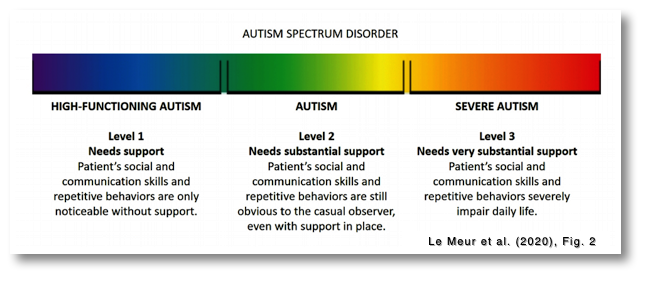
Autism Spectrum Disorders (ASDs) represent a range of developmental disorders (from mild to severe) in which individuals show
- significant impairment in social interaction and communication and
- severely restricted interests and activities, often performed repetitively
- usually seen by age 3.
The range of the spectrum involving autism runs from individuals how are "high-functioning" to individuals with severe autism who require significant support in their lives.
Symptoms
Across the world, an estimated 50-55% of individuals with an ASD diagnosis display significant intellectual disability (Russell et al., 2019)Difficulties in Social Communication and Social Interaction
● Making little or inconsistent eye contact
● Speech is compromised (1/3 never develop speech
● Bonds with parents or peer relationships may be weak or absent
● Not responding or being slow to respond to one’s name or other verbal bids for attention
● Having difficulties with the back and forth of conversation
● Often talking at length about a subject of interest without considering social cues or conversational give-and-take
● Having trouble understanding another person’s point of view or being unable to predict or understand other people’s actions
● Difficulties adjusting behavior to different social situations
● Difficulties sharing in imaginative play or in making friends
Restrictive or Repetitive Behaviors
● Repeating certain behaviors or having unusual behaviors, such as repeating words or phrases (a behavior called echolalia)
● Having a lasting intense interest in specific topics, such as numbers, details, or facts
● Showing overly focused interests, such as with moving objects or with parts of objects
● Becoming upset by slight changes in a routine and having difficulty with transitions
● Some ASD children engage in self-harming behaviors such as banging their heads against objectsSensory Differences
● Being more sensitive or less sensitive than other people to sensory input, such as light, sound, clothing, or temperature
Strengths: Some individuals on the spectrum also demonstrate various kinds of strengths, such as
- Learning things in detail and remembering information for long periods of time
- Doing well in certain school subjects such as math, science, music, or art
- Being strong visual and auditory learners
Prevalence (Tafolla et al., 2025)
- Twenty-five years ago (around 2000) the overall prevalence of autism was estimated at less than 1%, i.e., 1 in every 150 children
- Since 2000, the estimated prevalence has steadily increased to at least 1 in 36 children in the U.S.
- An estimated 2.21% of the adult population over 18 years have autism (though this may be an underestimate). Symptoms of autism among adults may have been hidden or camouflaged earlier in life and only appear in adolescence or adulthood.
- Why has the prevalence of autism so dramatically increased?
- Despite what RFK Jr. and others have said in 2025, there is no scientific evidence linking autism to childhood vaccinations. "Numerous robust scientific studies have found no links between vaccines and autism. The components of the vaccines (thimerosal or mercury) or multiple vaccines, such as the mumps-measles-rubella vaccine, are not associated with the development of autism or autism spectrum disorder" (Hodis et al., 2025).
- The criteria for ASD has been expanded to include a larger range of disorders, i.e., individuals may be diagnosed on the spectrum with much milder forms of autism than originally described back in the 1940s. Thus, our understanding of autism has changed.
- Furthermore, there has been "Increased awareness of autism and declining stigma among teachers, health professionals and the broader public alongside increased availability of diagnostic and support services" (Pearson, 2025, p. 861).
- Males = 80% of individuals with the diagnosis (while females often have more severe impairments and ASD in women may be under-diagnosed and only recognized in adulthood)
Etiology (Causes):
- The early appearance of ASD in children (and, even, regression by age 3 or 4 from previous developmental abilities) strongly suggests a biological basis for the disorder.
- Some evidence from brain studies show that early in the brain development of autistic children there is an early proliferation or overabundance of neural cells in the months after birth. It is not clear what the reason(s) may be for this finding.
- Family and twin studies have found that there are over 100 genes associated with autism and, thus, autism has a significant genetic contribution (Tofalla et al., 2025).
- Other possible causes include
- Advanced parental age
- Prenatal exposure to air pollution or certain pesticides
- Maternal obesity, diabetes or immune system disorders
- Extreme prematurity or very low birth weight
- Birth complications leading to periods of oxygen deprivation to the baby’s brain
References
“Autism Spectrum Disorder” (ASD) (2025). National Institute of Mental Health. https://www.nimh.nih.gov/sites/default/files/documents/health/publications/autism-spectrum-disorder/autism-spectrum-disorder.pdf
DeLisi, L. E. (2020). What a clinician should know about the neurobiology of schizophrenia: A historical perspective to current understanding. Focus, 18(4). https://dx.doi.org/10.1176/appi.focus.20200022
Hodis B, Mughal S, Saadabadi A. (2025, Jan. 17) Autism Spectrum Disorder. In StatPearls [Internet]. Treasure Island (FL): StatPearls Publishing. https://www.ncbi.nlm.nih.gov/sites/books/NBK525976/
Le Meur, O., Nebout, A., Cherel, M., & Etchamendy, E. (2020). From Asperger autism to Kanner syndromes, the difficult task to predict where ASD people look at. IEEE Access, 8, 162132-162140.
Pearson, H. (2025) What’s really driving the rise in autism? Nature, 644, 860-863.
Richter (2024, April 2). The rising prevalence of autism. STATISTA. https://www.statista.com/chart/29630/identified-prevalence-of-autism-spectrum-disorder-in-the-us/
Russell, G., Mandy, W., Elliott, D. et al. (2019) Selection bias on intellectual ability in autism research: a cross-sectional review and meta-analysis. Molecular Autism 10, 9. https://doi.org/10.1186/s13229-019-0260-x
Tafolla, M., Singer, H., & Lord, C. (2025). Autism spectrum disorder across the lifespan. Annual Review of Clinical Psychology, 21, 193-220. https://doi.org/10.1146/annurev-clinpsy-081423-031110
This page was originally posted on 11/24/03