![[Home]](../psy101graphics/homep.gif) Last update Oct. 26, 2025 |
PSY
101
![[Psychology Images]](../psy101graphics/intro_25.jpg) Class 25: Personality I: The Big Five and
Psychoanalysis
Class 25: Personality I: The Big Five and
Psychoanalysis |
|
Last update Oct. 26, 2025 |
PSY
101
Class 25: Personality I: The Big Five and
Psychoanalysis |
|
Think of some of the most vivid individuals in contemporary life over the last 20 years...





What are they like? Why are they like this?
| Personality |
In their behavior, human beings tend to be
- Consistent: tendency to behave regularly in a certain way
- Distinctive: each person has a particular set of individual or characteristic qualities or combination of traits
| Trait Theory: The "Big Five" |
Robert McCrae 
Paul Costa
The "Five-Factor" Theory (FFT; also known at the "Big Five" model) argues that personality characteristics are grounded in five basic traits, i.e., a set of durable dispositions to act or behave in a certain way across different situations. Our personalities are varying mixtures and combinations of these five traits.
Susan Cain: Quiet: The Power of Introverts (2012)
TED Talk: Feb 2012
OCEAN: Openness to Experience,
Conscientiousness, Extraversion, Agreeableness,
Neuroticism
Openness to Experience Inquisitive, intellectually curious, sensitive to beauty, nonconforming, imaginative, tolerant, thinker, dreamer
Pragmatic, data-driven, conforming, down-to-earth, non-artistic, conventional Closedness
Conscientiousness Dependable, ethical, goal-directed, organized, self-directed Aimless, unreliable, sloppy, careless Lack of Direction
Extraversion Outgoing, sociable, talkative, affectionate
Sensitive to rewards found in social interactions
Inward-looking, secure with self, solo reflection, quiet
Find experiences in social settings less rewarding
Introversion is NOT a negative personality trait
Introversion Agreeableness Warm, pleasant, trusting, empathetic Unpleasant, argumentative, always competitive Antagonistic Neuroticism Neurotic, anxious, guilty, hostile, worrying, shy, withdrawn
Secure, placid, flexible, unruffled, solid Emotionally Stable
- The 5 factors (OCEAN) appear to be moderately to highly heritable.
- After childhood and adolescence, the 5 factors tend to remain relatively stable across the life span.
Some Correlations with Life Outcomes
- Note that the correlations below are significant but not very close to r = 1.0. Therefore, there are multiple other factors of personality, genetics, life history, etc. related to these outcomes. Indeed, each of the "Big 5" factors may only be a small contributor to these specific outcomes.
- Note, too, that correlation does NOT equal causation. Thus, someone who scores at one or the other side of these factors may not necessarily be prone to the outcome stated.
Openness to Experience (possibly) longer life
Intelligence
Plays musical instrument
Left-wing political identification
Right-wing political identification
Closedness
Conscientiousness Career success
Lower illness
Longer life (> 5 years)
Honesty
Addictive disorders (ETOH, nicotine, cannabis, gambling)
Making poorer health choices
Higher levels of mental disorders
Lack of Direction Extraversion Career success
Social popularity
Party goer
Working in areas which permit freedom from distraction, e.g., accounting, architecture, psychologist, computer programming, writing
Introversion Agreeableness Lower divorce
Honesty
Lower income
Higher income among men
Addictive disorders (ETOH, nicotine, cannabis, gambling)
Antagonistic Neuroticism Lack of career success
Divorce
Mental & physical illness
Loneliness
Addictive disorders (ETOH, nicotine, cannabis, gambling)
Intelligence
Emotionally Stable
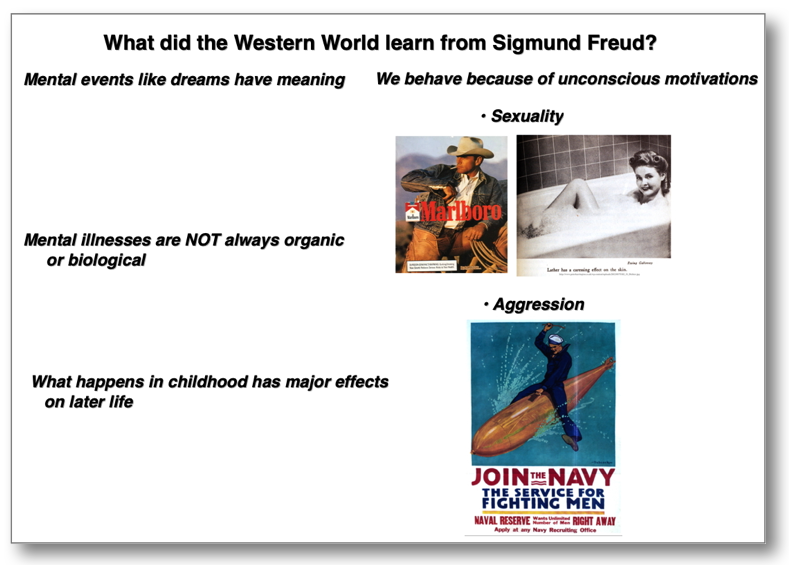
| Psychoanalytic (Freudian) Theory |
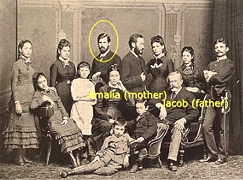
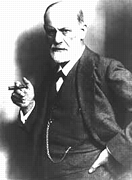
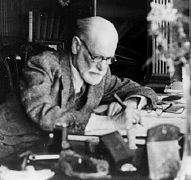
Sigmund Freud (1856-1939)
- Came from middle-class Jewish household & raised in Vienna, Austria & trained as a doctor specializing in neurology.
- Many early patients (late 1880s-early 1890s) came to him with vague symptoms of anxiety, unexplained weaknesses and paralyses, and other impairments without clear-cut origin. His approach to treating these patients was increasingly comprised of innovative strategies which he would eventually label as "psychoanalysis".
- His treatment in psychoanalysis required his patient to lie on a couch and say whatever came to mind without censoring any thought. The material included dreams the patient had. Over the course of many sessions, patterns became clear about what sorts of conflicts were occurring in the patient's unconscious mind.
Structure of the Personality
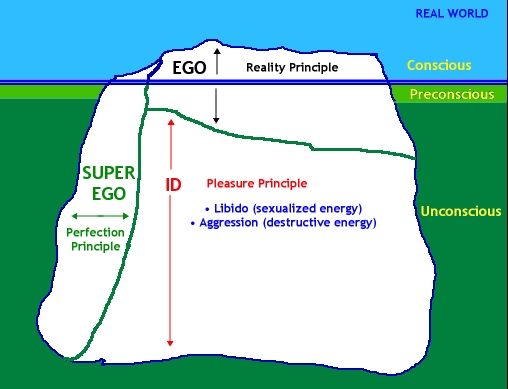
Freud actually had TWO (2) different but complementary theories of how we as persons are constituted. One is a structure of personality model and the second is a "level of consciousness" model.
Structure of Personality Model
Id
(Latin for "It")The primitive component of the personality, completely unconscious, which is filled with tremendous psychic energy (which Freud termed "libido"). This energy forms a set of biological urges to eat, defecate, engage in sex, etc.
After World War I, Freud also proposed the presence of an aggressive (destructive) energy [which he termed "Thanatos" (the "Death" instinct)].
- Operates according to the Pleasure Principle: the demand for instant gratification of all its urges
- Acts like a 2-year-old child
Ego
(Latin for "I")The last component of the personality to develop fully, the ego mediates among the demands of the id, the superego, and reality (the world).
It is always making decisions about how best to act.
- Operates according to the Reality Principle: that behavior accord with what the world accepts (requires delay of gratification & often a modification of how urges are met)
- Acts like an "Adult Executive"
Superego
(Latin for "Above I")Arising in childhood around ages 4-6 as a response to parental demands, the superego serves as a moral component of the personality. Mostly unconscious, the superego has incorporated the rules, regulations, and moral viewpoints of society, particularly those of parents. That small part of the superego which is conscious is our conscience.
- Operates according to the Perfection Principle which requires that behavior be morally perfect or be punished
- Acts like an "uncompromising 7-year-old"
Levels of Awareness (or Consciousness) ModelConscious = What we are currently aware of (thoughts, memories, desires, goals, etc.) at any particular point of time
Preconscious = What we can easily become aware of (memories, etc.) which are just below the surface of consciousness
Unconscious = What we cannot easily become aware of (thoughts, memories, desires, urges, goals etc.) that are deeply buried beneath the surface but which continue to exert significant control on our behavior
The graphic below uses the metaphor of the iceberg which is mostly below water (i.e., below the level of consciousness) to portray Freud's two theories of how the mind works.
Conflict and the Tyranny of Sex and Aggression
- In Freud's understanding of personality, our external behaviors are the result of internal wishes or desires by or conflicts among the id, ego, and superego.
- The focus of these conflicts involve how to express libido (sexual energy) and aggression in daily life.
Anxiety and Defense Mechanisms
Conflicts within the psyche (mind) which involve sexuality and aggressive wishes are sometimes unresolved and habitually influence ways in which individuals act in the world. These conflict show up in the form of defense mechanisms.
Defense Mechanisms = psychological responses by which our mind changes, redirects, or eliminates unbearable or high levels of anxiety arising from (1) conflicts between the demands of the id (pleasure) versus the superego (perfection) or (2) between the id (pleasure) and reality (as understood by the ego) or (3) unbearable traumatic memories.
Many different mechanisms have been described. Some of these include the following.
- Repression: the mind literally blots out all memory or awareness of a traumatic memory or experience
- Projection = attributing one's own thoughts, feelings, and desires to another. A person who unconsciously has an unacceptable desire or feeling will deal with it by saying that it is someone else who has those feelings.
- Intellectualization: to avoid the painful feelings of emotions or certain desires, the individual speaks or thinks about them in unemotional ways and emphasizes the thoughts or ideas rather than the feelings. For example, after surviving a terrible car crash, someone might talk about the details of the car's speed, the road conditions, etc., without ever acknowledging a fear of injury or dying.
- Reaction Formation: an individual who has a strong set of unacceptable feelings such as anger will behave in the opposite way, e.g., the person who is "extra" nice or especially pleasant may be covering over very different kinds of feelings.
- Sublimation: an individual who may have strong sexual or aggressive feelings will transform those feelings by means of creative activity such as painting, music composition, novel writing, or volunteering to aid other people.
Note that different psychiatrists, psychoanalysts, and clinical psychologists have identified and described more than 20 different defense mechanism found across the spectrum from psychologically mature to psychotic individuals.
Stages of Psychosexual Development
We've already looked at the way in which Erik Erikson altered Freud's understanding of development. Here is the original outline. Freud argued that we grow up through a set of psychosexual stages in which difference parts of our bodies become the focus of our erotic (libidinal) energies.
Age Erotic Focus Experiences Oral Birth-1 Mouth: Sucking, feeding, biting Experience of mother's breast; weaning Anal 2-3 Anus: Expelling or retaining feces Toilet Training Phallic 4-5 Genitals: Masturbatory stimulation Oedipal Crisis: Identification with same-sex parent Latency 6-12 None (repression of sexual feelings) Learning in school and social contact with outside world Genital From onset of puberty Genitals: Sexual intimacy & intercourse Developing capacity for Love and Work (Lieben und Arbeiten)
This page was originally posted on 10/24/03