![[Home]](../psy101graphics/homep.gif)
![[Psychology Images]](../psy101graphics/intro_25.jpg) Class 23: Motivation II: Sexuality
Class 23: Motivation II: Sexuality
|
PSY
101
Class 23: Motivation II: Sexuality |
|
Sexual Motivation & Behavior Note that there is an upper division course, PSY 360 Human Sexuality, that covers this material in far greater depth.
A. The Human Sexual Response Cycle
Masters and Johnson. Up to 1966, we knew very little about what happened to the human body as it engaged in sexual behavior. That was the year that William Masters (1915-2001) and Virginia Johnson (1925-2013; see photo to the left) published their groundbreaking study, Human Sexual Response. Using a variety of recording and observation techniques with volunteers, Masters & Johnson for the first time detailed the very many changes that go on in the male and female body during the course of sexual intimacy. They proposed a four-stage theory of the "human sexual response cycle" and detailed characteristic physiological changes associated with each stage. These stages in the cycle include (1) excitement, (2) plateau, (3) orgasm, and (4) resolution. Four years later, in 1970, they followed their first book by a second, Human Sexual Inadequacy. In this volume they describe what goes wrong with the normal course of sexual activity in adults and detail treatment approaches in response to these forms of sexual disorder. [Wikipedia entry]
Physiological Changes during the Phases of the Human Sexual Response Cycle as uncovered by the work of Masters & Johnson. These are detailed here simply to illustrate that there are clear physiological changes in the body that are found in different stages of the experience of sex.
Excitement & Plateau
- Vasocongestion (constriction of blood vessels) in sexual organs.
- In males, erection of the penis while the testes elevate and become engorged with blood.
- In females, the clitoris becomes larger, the labia majora separate, and the labia minora enlarge (and darken in color)
- Mytonia (increased muscular tension)
- Increased heart rate & blood pressure
- Sex flush (on chest and breasts)
Plateau => intensification of Excitement phase. In women the outer 1/3rd of the vagina becomes particularly engorged with blood
Orgasm
Resolution
- Rhythmic muscular contractions of the sexual organs accompanied by experience of strong pleasure
- In males, ejaculation of semen accompanies contractions.
- Studies of both males and females show nearly identical descriptions of the feelings & experience of orgasm.
- In the absence of further sexual stimulation, the body returns to normal. The pace at which this happens is different for different people.
![[Human Sexual Response
Cycle: Male]](../psy101graphics/hsrc_male.jpg) |
![[Human Sexual Response
Cycle: Female]](../psy101graphics/hsrc_female.jpg) |
Females
Masters & Johnson reported three normal variations among women in the sexual response cycle. (see diagram above)
A. Female experiences orgasm and enters the period of resolution.
B. Female experiences intense levels of sexual stimulation (equivalent to the Plateau stage) without orgasm
B. Evolutionary Analyses of Human Sexual Motivation
• Consider the danger of
pregnancy faced by women historically
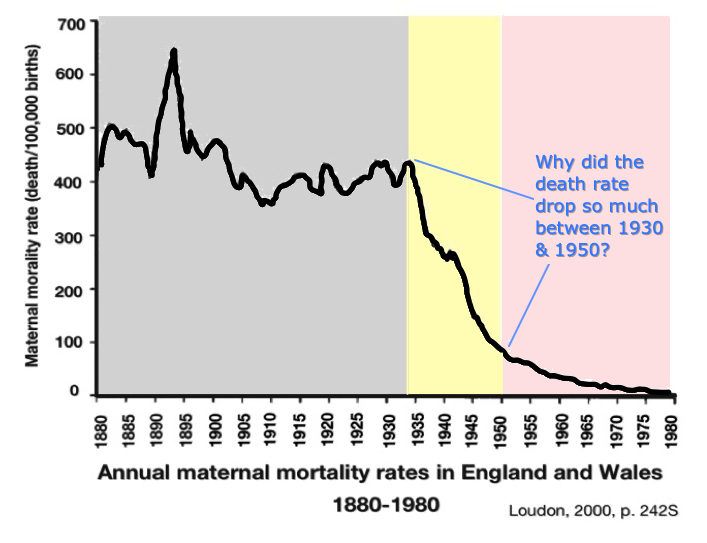
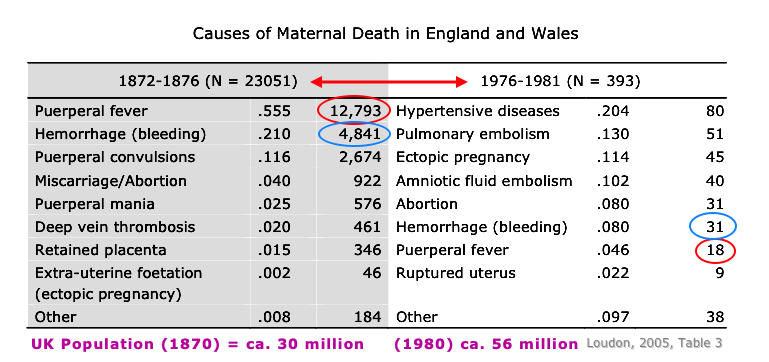
• What are the differences between the causes of maternal death in the 19th & 20th centuries?
Note: ("puerperal" means "around the time of birth")
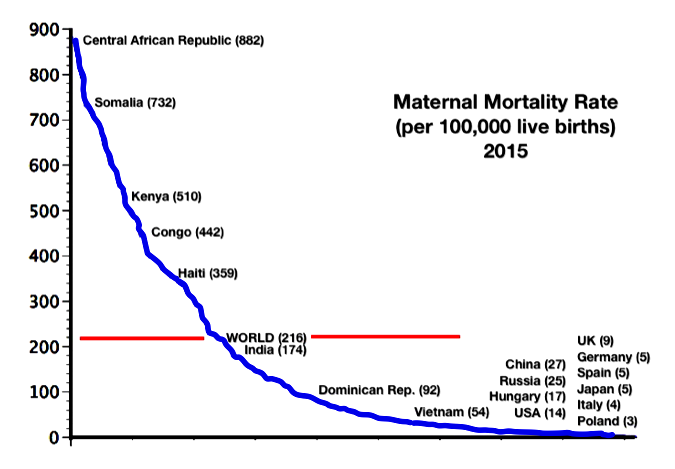
• Consider the danger of
pregnancy faced by women in low-income nations today
Robert Trivers' Parental Investment Theory
Parental Investment = what each sex has to invest (i.e., time, energy, survival risk, and foregoing other opportunities) in order to produce and nurture offspring.
- The sexual partner who faces the least investment risk will compete with others for mating opportunities with the partner who faces the most investment risk. In humans, this is (normally) the male.
- The sexual partner who faces the most investment risk will be more discriminating (choosy) about selecting a sexual partner. In humans this is (normally) the female.
- In this theory, evolution has endowed each gender (sex) with different mating strategies with the overall goal of successfully passing on one's genes.
Gender Differences: Are there such
differences in what people actual do?
Sexual Activity
M(ales) tend to be > F(emales) in respect to
- Interest in sex
- Thinking about sex
- Initiating sexual contact
- Desire a greater number of partners
- Have a greater number of partners
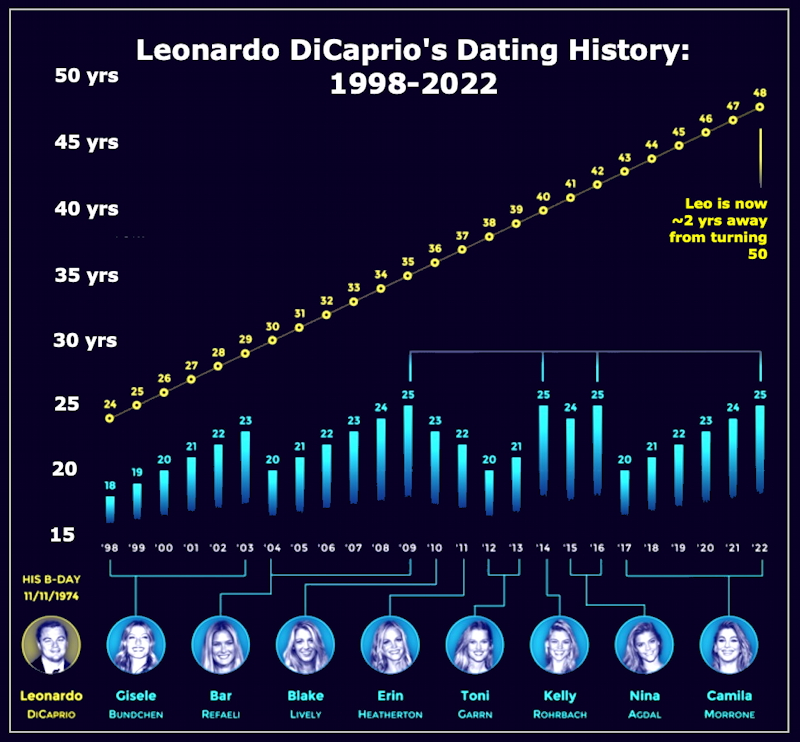 Mate
Preferences in Evolutionary Theory
Mate
Preferences in Evolutionary Theory
- Evolutionary Theory: M prefer F with youthfulness (indicator of reproductive potential) & attractiveness (indicator of health)
- Evolutionary Theory: F prefer M with higher social status, intelligence, education, income & financial resources (all indicators of ability to provide and protect)
- Research: By psychologist David Buss (1989) -- survey of 10,000 people from 37 cultures worldwide -- F value social status, ambition, and financial prospects of M while M value youth & physical attractiveness in F
Relationship Jealousy in Evolutionary
Theory
- Evolutionary Theory: Males concern with paternity uncertainty: are they actually the father of the child? Thus, partner infidelity would be particularly threatening to a male.
- Research: David Buss (1992) -- US study -- M showed greater distress at sexual infidelity than F while F showed greater distress at emotional infidelity than
Critiques of Evolutionary Theory
- Ignores the impact of cultural and economic forces worldwide which place F at material disadvantage.
- Males are strongly formed by culture to live out gender-role stereotypical behaviors
- NEW: Psychologists such as Marcel Zenter & Alice Eagly (2015) argue that men and women choose mates NOT dependent upon inherited evolutionary genetics, but on the current prospects for advancement and security in their own social worlds: they "prefer and choose mates whose attributes they believe will facilitate their well-being in the circumstances that they face in their own lives, and these beliefs are shaped by people’s expectations for women and men—that is, societal gender roles" (p. 329). They conclude: "“[T]he cross-cultural evidence reviewed here points to a strong and systematic association between nations’ progress toward gender equality and the waning of sex differences in partner preferences—even including the appearance of some reversals of the traditional sex-related difference among nations with a high gender equality score…” (p. 345, emphasis added)" [See, too, Zentner, 2017]
C. The Mystery of Sexual Orientation
Note: The material below reviews research and concepts related to sexual orientation, not gender identity. The issue of gender identity is clearly an increasingly discussed issue in the United States, especially among people of the current college-age generation, but it is one which I will not be looking at.
What causes homosexuality? This question should be asked with the correlative one: What causes heterosexuality? In other words, before asking the origins of homosexuality, scientists are challenged to explain sexual attraction and orientation more generally.
Sexual Orientation: a preference for emotional and sexual relationships with partners of the same (homosexual), other (heterosexual), or either sex (bisexual).
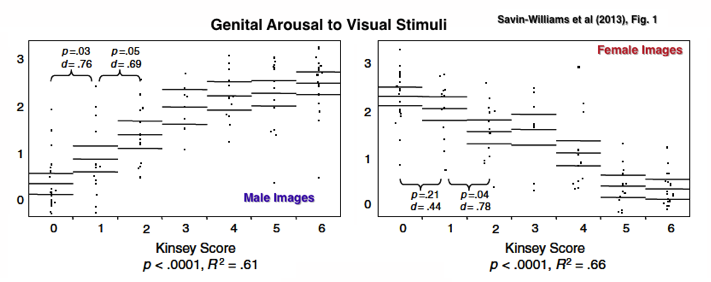
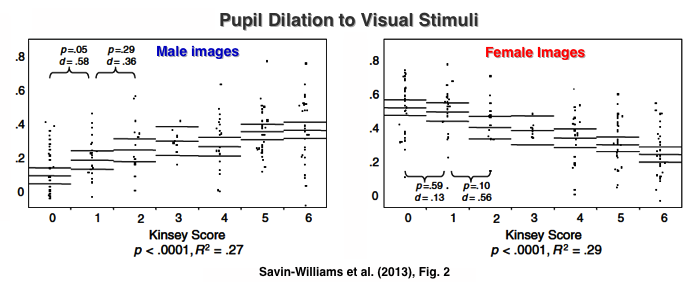
Data suggest that the heterosexual-homosexual distinction is not an either/or proposition, but represents something of a continuum. The groundbreaking study of male sexuality by Alfred Kinsey (on right) in 1948, [which was not representative of the general population] proposed that sexual orientation be rated on a 7-point scale from exclusively heterosexual (rating of 0) to exclusively homosexual (rating of 6). He challenged sexual orientation as a simple binary category (only two choices).
For example, Savin-Ritch and his colleagues (2013) studied the sexual arousal patterns of adult males to sexual images of males and females in terms of male genital arousal and pupil dilation. Their data suggested a distinctive continuum of responses consistent with Kinsey's original conception.
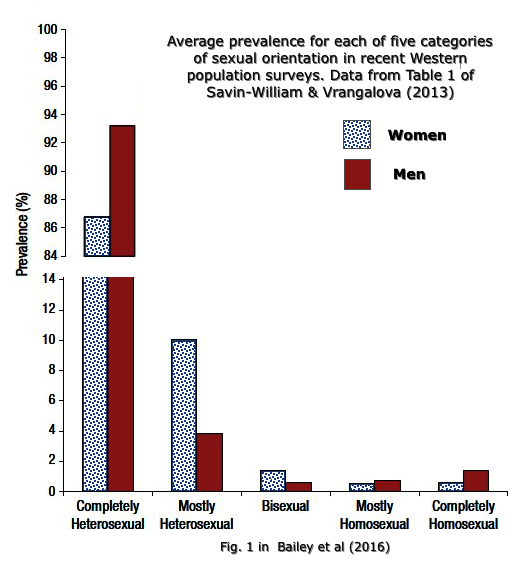
Prevalence of homosexuality. How many people in the United States are homosexual? This is a hard question to answer for at least two reasons: (1) definitional difficulties (how do we define homosexuality in light of what was just said about the sexual orientation continuum?) and (2) data collection difficulties (many people are reluctant to respond to sexual orientation questions honestly because of factors such as fear, shame, etc.) However, a variety of surveys and other data from the late 1980s to the 2000s (as well as more recent reports summarized in Bailey et al., 2016) suggest that
- about 1 to 3% of the adult male US population is now mostly or exclusively homosexual
- another 1 or 2% of the adult male US population may have strong or complete homosexual arousal patterns but for various reasons do not publicly identify as gay or homosexual (e.g., they may be in a heterosexual marriage, still be closeted, etc.)
- the percentage of women who are exclusively homosexuals (lesbian) is probably lower than the percentage of males, i.e., 1-2% of women are lesbian.
- However, a higher percentage of women than men report bisexual feelings, particularly those in close personal relationships.
- The geographical distribution of adult homosexuals in the United States is quite varied by state (see map). The New England and West Coast states have a far higher homosexual population than the Midwest, Northern Mountain and most Southern states.
Some Further Cautions about Research into Sexual Orientation
- Note that I have not addressed what are called "intersex" conditions in which the binary biological status of male vs. female in a small percentage of the population (<1%) is uncertain and how such conditions relate to sexual orientation. This is a topic that I deal with in PSY 340 Brain and Behavior rather than in PSY 101.
- Self-Identified Gender Identity (Jones, 2022)
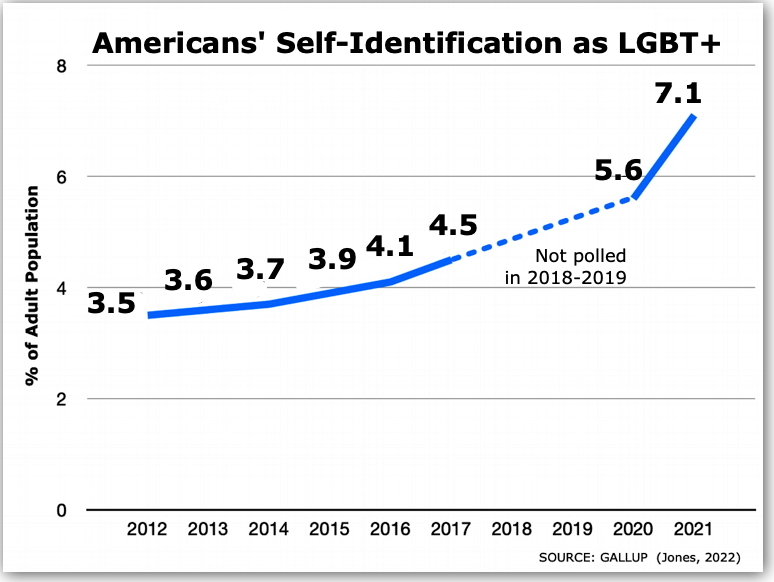
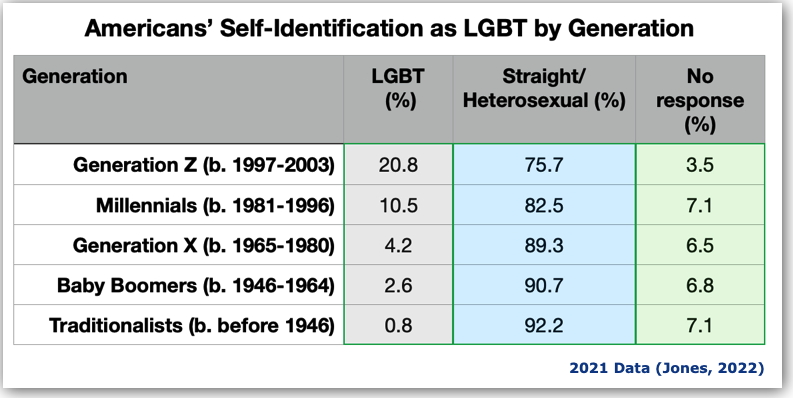
- Note that over the past decade (and particularly in the last 5 years) there has been a significant shift in how American adults identify themselves as "straight/heterosexual" versus choosing one or other among the LGBTQA+ self-identifying labels.These changes may bring into question some of the summary data presented earlier.
- In recent years very significant differences in the percentage of Americans identifying as LGBTQA+ have emerged according to generations. As the data above on the right illustrate, younger adults are far more likely to say that they are LGBT rather than older adults. The reasons for this change are not clear or well-understood. This would be the sort of issue which you may find discussed in the PSY 360 Human Sexuality course.
1. Environmental or Early Life Factors associated with Homosexual Orientation
- No or minimal scientific evidence to support older environmental theories, i.e.,
- Freudian (psychoanalytic): boy raised by weak, ineffectual father and domineering, overprotective mother
- Behavioral: child develops preference for same-sex stimulation because of learning from experiences such as male adult seduction
- Gender Nonconforming Behavior (GNCB). Extreme stereotypical "feminine" behavior in younger boys is predictive of later gay orientation (for 75-90% of such boys). However, "feminine" behavioral characteristics are seen in only 15 to 20% of male adult homosexuals (conversely, the behavior of roughly 80 to 85% of gay males is generally indistinguishable from that of most "straight" males). Hence, most adult male homosexuals did not display "feminine" behaviors as children.
- GNCB in females is also predictive of adolescent lesbian sexual orientation, but somewhat less strongly than found among adolescent homosexual males. Note, however, that studies of GNCB in girls/women are far less numerous than among boys/males. And, adolescent and young adult women report a less firm sense of sexual orientation/sexual identity than do males of the same age.
- Most male and female homosexuals report feeling different at an early age, i.e., looking back as adults and seeing in their early childhood feelings and leanings toward same-sex friends before sexuality itself became a conscious issue.
2. Biological Factors associated with Homosexual Orientation
- Hormonal Difference Theory in Adults: NO evidence to support differences in sexual hormone levels in adult homosexuals
- Genetic Similarity or Relatedness Studies
- Monozygotic twins are more likely to be concordant for homosexuality (ca. 50% concordance rate) than dizygotic (fraternal) twins (ca. 20%) or adoptive brothers (ca. 11%). This pattern is seen among lesbians as well.
- Fraternal Birth Order Effect (not in text but very important)
- Though our text doesn't mention it, there is substantial research showing that homosexual orientation in males occurs at higher rates among the younger brothers in a family, that is, the greater the number of older brothers, the greater the chance of a younger brother showing same-sex orientation. Note, though, that a large majority of younger brothers will not be homosexual even according to this hypothesis.
- Bailey et al. (2016) explain: “Male fetuses carry male-specific proteins on their Y chromosome, called H-Y antigens. [Researcher Ray] Blanchard (2001) hypothesized that some of these antigens promote the development of heterosexual orientation in males (it is likely that such development also requires circulating testosterone at a critical period). Because these H-Y antigens are not present in the mother’s body, they trigger the production of maternal antibodies. These antibodies bind to the H-Y antigens and prevent them from functioning, which, in turn, impedes sexual differentiation of brain centers mediating male sexual orientation. (pp. 79-80)
- Prenatal Hormonal Differences.
- The organizing effects of prenatal hormones upon the nervous system during critical periods of the developing fetus may be responsible for a predisposition toward homosexuality. Note that this explanation is also compatible with the Fraternal Birth Order Effect explained above.
- Anatomical Difference Studies
- In the early 1990s, Simon LeVay found differences in a small area of the hypothalamus in the brains of 19 homosexuals and 16 heterosexual men following autopsy. Such differences may be explained by differences in hormonal secretions during critical periods of gestation (pregnancy) when the brain of the fetus is being "wired" for sexual orientation.
- LeVay's findings have been partially replicated by other researchers afterwards (particularly Byne et al., 2001)
Bottom Line: Most scientific researchers believe that homosexual and heterosexual orientations are the result of interacting genetic and environmental processes which take place early in the development of the child (particularly during gestation). Thus, there is almost certainly no "gay gene" and there is probably no "gay environment" which causes homosexual orientation.
The most recent comprehensive review of non-heterosexuality is Bailey et al. (2016, 57 pages) listed below. Additionally, the current entry in Wikipedia on Biology and Sexual Orientation is very long, detailed, and shows the complexity of this topic.
References
Blanchard, R. (2001). Fraternal birth order and the maternal immune hypothesis of male homosexuality. Hormones and Behavior, 40, 105–114. https://doi.org/10.1006/hbeh.2001.1681
Byne, W., Tobet, S., Mattiace, L. A., … Jones, L. B. (2001) The interstitial nuclei of the human anterior hypothalamus: An investigation of variation with sex, sexual orientation, and HIV status. Hormones and Behavior, 40(2), 86-92. https://dx.doi.org/10.1006/hbeh.2001.1680
Eastwick, P. W., Eagly, A. H., Glick, P., Johannesen-Schmidt, M. C., ... Volpato, C. (2006). Is traditional gender ideology associated with sex-typed mate preferences? A test in nine nations. Sex Roles, 54: 603-614. https://doi.org/10.1007/s11199-006-9027-x
Jones, J. M. (2022, February 17). LGBT identification in U.S. ticks up to 7.1%. Gallup. https://news.gallup.com/poll/389792/lgbt-identification-ticks-up.aspx
Loudon, I. (2000). Maternal mortality in the past and its relevance to developing countries today. American Journal of Clinical Nutrition, 72(suppl.), 241S-246S
Purcell, D. W., Johnson, C. H., et al. (2012). Estimating the population size of men who have sex with men in the United States to obtain HIV and syphilis rates. Open AIDS Journal, 6, 98-107. https://doi.org/10.2174/1874613601206010098
Savin-Williams, R. C., Rieger, G., & Rosenthal, A. M. (2013) Physiological evidence for a mostly heterosexual orientation among men. Archives of Sexual Behavior, 42, 697-699. https://doi.org/10.1007/s10508-013-0093-1
Zenter, M. (2017, Dec. 21). Men want beauty, women want wealth, and other unscientific tosh. AEON Ideas. https://aeon.co/ideas/men-want-beauty-women-want-wealth-and-other-unscientific-tosh
Zentner, M. & Eagly, A. E. (2015) A sociocultural framework for understanding partner preferences of women and men: Integration of concepts and evidence. European Review of Social Psychology, 26(1), 328-373. https://doi.org/10.1080/10463283.2015.1111599
This page was originally posted on 10/16/03 and last updated on October 18, 2025
![[Masters
& Johnson]](../psy101graphics/masters_johnson.jpg)
![[Kinsey]](../psy101graphics/kinsey.jpg)