- Carl Ferdinand Cori born 1896: carbohydrate metabolism; discovered how glycogen is catalytically converted; Nobel Prize (medicine), 1947 (with wife Gerty)
- Werner Heisenberg born 1901: quantum mechanics (matrix mechanics); Heisenberg uncertainty principle; Nobel Prize (physics), 1932. See page images of uncertainty principle paper (auf Deutsch).
- Hans Landolt born 1831: Landolt-Börnstein physical chemical tables; see page images of the 1905 edition (auf Deutsch) or read a description of the current product.
- Christian Friedrich Schönbein received US patent 4,874 for guncotton, 1846.
- Charles Frederick Chandler born 1836: researcher in sugar, petroleum, and illuminating gas industries; a founder of the American Chemical Society
- Rudolph Fittig born 1835: organic synthesis (e.g., lactones, toluene); Wurtz-Fittig reaction; discovered diphenyl phenanthrene and coumarone (benzofuran)
- Louis-Joseph Gay-Lussac born 1778: law of expansion of gases with increasing temperature; law of combining volumes of gases; isolated boron (B, element 5); research on chlorine, fermentation, prussic acid, and composition of water.
- Charles Martin Hall born 1863: discovered method of extracting aluminum electrolytically from bauxite (in his garage). Read more about his relevant patents.
- King James I charters the first English organization of pharmacists ("Master, Wardens and Society of the Art and Mystery of the Apothecaries of the City of London"), 1617 (Julian calendar).
- Nicolas Leblanc born 1742: Leblanc process for making sodium bicarbonate (NaHCO3) from common salt.
- George Porter born 1920: developed flash photolysis technique for chemical kinetics; Nobel Prize, 1967
- George Eugene Uhlenbeck born 1900: electron spin.
- First thermosetting manmade plastic ("Bakelite") patented, 1909 (US patents 942,699 and 942,700 to Leo Baekeland): reaction involved phenol and formaldehyde.
- Imperial Chemical Industries (ICI) incorporated, 1926.
- Theodor Schwann born 1810: named and investigated pepsin; coined the word metabolism.
- Eugene Cook Bingham born 1878: plastic flow and viscosity
- Thomas Robert Cech born 1947: discovered cellular role of ribonucleic acid (RNA); Nobel Prize, 1989.
- Jan Ingenhousz born 1730: early work on the phenomenon of photosynthesis, including a description of the production of oxygen by plants (part of his Experiments upon Vegetables, 1779).
- Thomas Edward Thorpe born 1845: atomic weights, viscosity of liquids, and chemical analyses
- Claude-Louis Berthollet born 1749: steps toward the law of mass action; analysis of ammonia; discovered bleaching action of chlorine; discovered composition of prussic acid (HCN); showed that acids need not contain oxygen.
- Fritz Haber born 1868: high-pressure synthesis of ammonia from hydrogen and nitrogen (Haber-Bosch process); Nobel Prize, 1918
- Angie Turner King born 1905 (as Angie Turner): one of the earliest African-American women to earn a degree in chemistry, she taught other successful African-American women scientists
- William Nunn Lipscomb, Jr. born 1919: three-dimensional structure of enzymes and proteins; research on boranes; Nobel Prize, 1976.
- Eilhard Mitscherlich read paper on isomorphism to Royal Academy of Science, Berlin, 1819.
- Carl Wilhelm Scheele born 1742: discovered chlorine (Cl, element 17); isolated oxygen ("fire air"); Scheele's green; isolated phosphorus (P, element 15) from bone ash; research on action of light on silver salts; synthesized organic acids
- First commercial experiment in nuclear mining conducted under New Mexico desert, 1967 ("Project Gasbuggy").
- Norbert Rillieux received US Patent 4879 for multiple effect evaporator for sugar refining, 1846.
- Max Born born 1882: quantum mechanics; interpretation of the wavefunction (Born interpretation); Born-Oppenheimer approximation in molecular quantum mechanics; Nobel Prize (physics), 1954.
- Emmanuelle Charpentier born 1968: CRISPR/Cas9 gene editing; Nobel Prize, 2020
- Charles Frederick Cross born 1855: rayon manufacture (cellulose acetate), cellulose and papermaking.
- Paul Greengard born 1925: biochemical action of dopamine and other neurotransmitters; Nobel Prize (Medicine), 2000.
- Vitamin B12 isolated by Merck, Sharp & Dohme Research Laboratories, 1947.
- Horace Wells, dentist, first used nitrous oxide as an anesthetic, 1844.
- Eugen Baumann born 1846: iodine in thyroid.
- First pure compound of californium (Cf, element 98) announced at 1960 meeting of American Nuclear Society.
- William Henry born 1775 (according to Britannica; other sources say 1774): discovered that the solubility of a gas in a liquid is proportional to the gas pressure (Henry's law). View his Epitome of Chemistry or Elements of Experimental Chemistry.
- Alfred Werner born 1866: coordination chemistry; inorganic complexes, stereochemistry; Nobel Prize, 1913
- Olaf Kristian Birkeland born 1867: first industrial fixing of nitrogen.
- Casein fiber patented, 1938, by Earle Whittier and Stephen Gould.
- William Henry Chandler born 1841: academic chemistry laboratory design and instruction in the US.
- Charles Alfred Coulson born 1910: Valence and molecular structure calculations.
- Johann Wolfgang Döbereiner born 1780: noted triads of elements with similar properties and a progression of atomic weight; catalytic action of platinum; invented instantaneous-lighting lamp (Döbereiner lamp)
- Perkin Elmer incorporated, 1939.
- Max Josef von Pettenkofer born 1818: calorimeter for human energy changes.
- Max Planck introduced the notion of light as quantized energy packets to the Deutsche Physikalische Gesellschaft, (German Physical Society) 1900.
- Glenn Seaborg, Edwin McMillan, Joseph Kennedy, and Arthur Wahl bombarded uranium oxide with 16-MeV deuterons to produce plutonium (Pu, element 94) in 1940.
- Edward Lawrie Tatum born 1909: discovered genes which regulate some chemical processes; Nobel Prize (medicine), 1958
- Antoine-Henri Becqurel born 1852: discovered radioactivity (Becquerel rays) from uranium salts; Nobel Prize (physics), 1903.
- Arthur Dehon Little born 1863: industrial and engineering chemistry, founded Arthur D. Little, Inc.; read a pamphlet on research and industrial development.
- Maurice Wilkins born 1916: X-ray crystallography of biological materials; DNA structure; Nobel Prize (medicine), 1962.
- Johann Wilhelm Ritter born 1776: electrolyzed water, collecting hydrogen and oxygen; discovered ultraviolet rays
- Allied Chemical and Dye Corp. (later part of Allied Signal, which merged with Honeywell) incorporated 1920.
- Émilie du Châtelet born 1706: chemical nature of fire (Dissertation sur la nature et la propagation du feu [en français]); better known for her mathematics and for her relationship to Voltaire.
- Humphry Davy born 1778: isolated barium (Ba, element 56), calcium (Ca, 20), magnesium (Mg, 12), potassium (K, 19), sodium (Na, 11), and strontium (Sr, 38); co-discovered boron (B, 5); recognized as elementary and named chlorine (Cl, 17); invented Davy mine safety lamp. His first work on heat and friction includes some insightful ideas and dubious experiments. Read some of his writings on sodium and potassium and on chlorine and its compounds. Read his Researches, Chemical and Philosophical; Chiefly Concerning Nitrous Oxide and his Elements of Chemical Philosophy.
- Michael Faraday enunciated first law of electrolysis, "Chemical power, like magnetic force, is in direct proportion to the absolute quantity of electricity which passes," 1832.
- Fission of uranium (U, element 92) by neutrons detected by Otto Hahn and Fritz Strassmann in Berlin, 1938; the interpretation of the event as fission would await a paper by Lise Meitner and Otto Frisch.
- Willard Frank Libby born 1908: developed carbon dating; Nobel Prize, 1960.
- John Lawrence Smith born 1818: toxicology and chemistry of minerals
- Mary Letitia Caldwell born 1890: isolation, structure, and activity of starch enzymes (amylases). Read her doctoral dissertation on amino acids.
- Joseph John (J. J.) Thomson born 1856: characterized "cathode rays", discovering a particle (the electron) with much smaller mass to charge ratio than any known up to that time; Nobel Prize (Physics), 1906. Thomson went on to determine the charge of cathode rays and identify them with other manifestations of electrons; his work on positive rays led to the development of mass spectroscopy; his work on the structure of atoms include his "plum pudding model" and an argument that the number of electrons in an atom was comparable to its atomic mass (in atomic mass units).
- Edgar Bright Wilson born 1908: vibrational spectroscopy (Molecular Vibrations [review, pdf]).
- Thomas Andrews born 1813: discovered critical temperatures of gases (temperature above which they cannot be liquefied); read his lecture on the continuity of the gaseous and liquid states.
- Berkelium (Bk, element 97) discovered by (left to right) Kenneth Street, Jr., Stanley G. Thompson, Glenn T. Seaborg, and Albert Ghiorso using ion-exchange chromatography at the Berkeley Radiation Lab (later named Lawrence Berkeley National Laboratory), 1949.
- Yvette Cauchois born 1908: x-ray spectroscopy (Cauchois spectrometer, use of synchrotron x-rays)
- Pauline Beery Mack born 1891: nutritional content of meat and vegetables; bone density studies; laundering behavior of textiles; Garvan Medal, 1950.
- Alan Walsh born 1916: atomic absorption spectroscopy.

- Einsteinium (Es, element 99) discovered by (left to right) Louise Smith, Sherman Fried, Gary Higgins; (back row) Albert Ghiorso, Rod Spence, Glenn Seaborg, Paul Fields and John Huizenga using ion-exchange chromatography at at the Berkeley Radiation Lab (later named Lawrence Berkeley National Laboratory, 1952.
- Thomas Graham born 1805: absorption of gases, osmosis, colloids, and dialysis; Graham's law of effusion
- Jaroslav Heyrovsky born 1890: invented polarographic method of analysis; Nobel Prize, 1959.

- John Mayow baptized 1641 (birth date uncertain): discovered that air contained two gases, one of which ("spiritus nitro-aerous") supported life and combustion. Read his Tractatus Quinque Medico-physici in English.
- Hermann Joseph Muller born 1890: theory of genes; mutation by X-rays; Nobel Prize (medicine), 1946.
- St. Elmo Brady born 1884: first African-American to earn a Ph.D. in chemistry.
- William Lloyd Evans born 1870: chemistry of carbohydrates; click for more details on carbohydrate nomenclature.
- Arie Jan Haagen-Smit born 1900: nature and source of smog; smog abatement.
- Vladimir Markovnikov born 1838: synthesis of cyclobutane and cyclopentane derivatives; Markovnikov's rule for additions to alkenes. (Read a recent article about a modern attempt to replicate Markovnikov's work on his eponymous rule.)
- John Clarke Slater born 1900: orbital approaches to quantum chemistry (Slater-type orbitals, Slater determinant); tetrahedral carbon compounds.
- M. Stanley Whittingham born 1941: lithium ion batteries; Nobel Prize, 2019
- Axel Fredrik Cronstedt born 1722: discovered nickel (Ni, element 28) and zeolite; classification of minerals
- Anna Jane Harrison born 1912: first female president of American Chemical Society (1978); president of the American Association for the Advancement of Science (1983-84).
- Stefan Hell born 1962: very high-resolution fluorescence microscopy; Nobel Prize, 2014.
- Helen Abbott Michael born 1857: chemical composition of plants; synthetic organic chemistry; author (under the pseudonym Celen Sabbrin), of Science and Philosophy in Art.
- Paul Schützenberger born 1829: physiological chemistry.
- James Prescott Joule born 1818: thermodynamics; mechanical equivalent of heat (Read his paper and view his apparatus); Joule-Thomson effect (temperature of gas falls when the gas expands without doing work); kinetic theory of gases
- Benjamin Rush born 1745: signer of Declaration of Independence; published first American chemistry textbook
- Augustus Vernon-Harcourt born 1834: invented 10-candlepower standard lamp using pentane
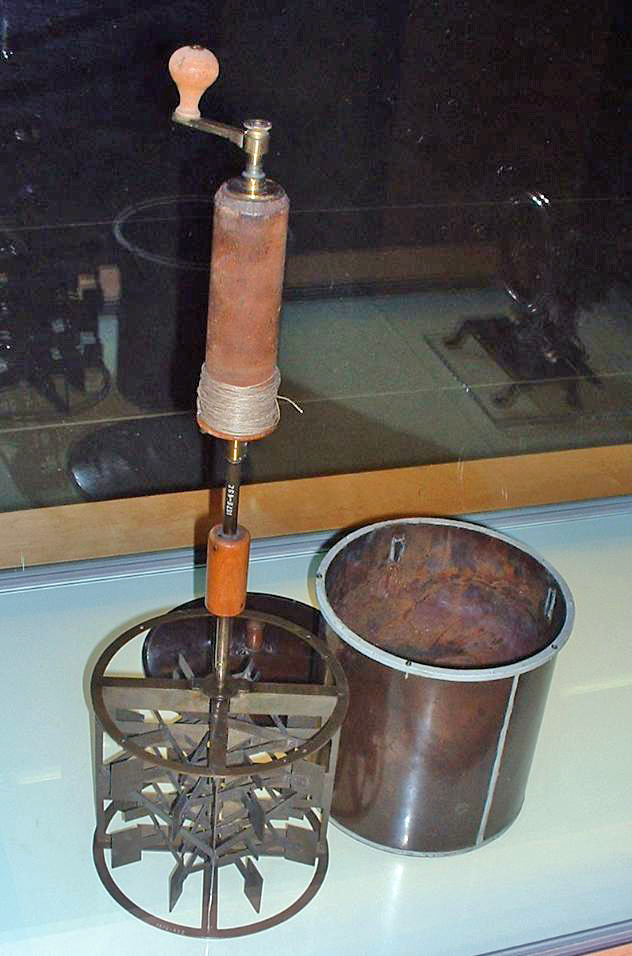
- Herman Frasch born 1851: sulfur mining (Frasch process, developed in Louisiana)
- William Gregor born 1761: discovered titanium (Ti, element 22); analysis of minerals
- Gerhard Herzberg born 1904: spectroscopic analysis of electronic structure and geometry of molecules and radicals; Nobel Prize, 1971
- Isaac Newton born 1642: made fundamental contributions to physics (gravitation, optics, mechanics) and mathematics (calculus); researcher in chymistry. (Read his ideas about atoms and the rest of his Opticks.)
- Ludwig Ferdinand Wilhelmy born 1812: chemical kinetics; first measurement of homogeneous reaction rate (or see entire paper auf Deutsch).
- Adolf Windaus born 1876: synthesis of histamine; structure of cholesterol; research on steroids; Nobel Prize, 1928
- Marie and Pierre Curie discover radium (element 88, Ra), 1898.
- Ali Javan born 1928: inventor of helium-neon laser, the first gas laser and first continuous-wave (CW) laser.
- Clemens Winkler born 1838: discovered germanium (Ge, element 32); analysis of gases
- Gerardus Johannes Mulder born 1802: protein analysis; physiological chemistry (including chemistry of wine).
- Louis Pasteur born 1822: research in molecular dissymmetry (optical activity of tartaric acids), fermentation, decomposition, microbes, and anti-microbial treatment of beverages (pasteurization)
- Ernest Eliel born 1921: organic stereochemistry and conformational analysis
- Karl Remigius Fresenius born 1818: qualitative and quantitative analytical chemistry
- Kary Mullis born 1944: developed polymerase chain reaction (PCR) for making copies of DNA; Nobel Prize, 1993
- Wilhelm Röntgen announced his discovery of new rays, 1895, inspiring research that would lead to a thousand papers on X-rays within a year.
- Lewis Hastings Sarett synthesized cortisone at Merck, Sharp & Dohme Research Laboratories, 1944.
- Ellen Gleditsch born 1879: nuclear chemistry; half life of radium.
- Charles Goodyear born 1800: vulcanization of rubber (US patent 3,633)
- Helen Vaughn Michel born 1932: neutron activation analysis, with applications to archeology and geology
- Alexander Parkes born 1813: invented parkesine (later called xylonite, a kind of celluloid); electroplating
- Harold Urey and co-workers announced discovery of deuterium, an isotope of hydrogen (H, element 1), 1931. (Link to a register of Urey's papers.)
- William David Coolidge of General Electric is issued US Patent 1,082,933 for ductile tungsten for incandescent bulb filaments, 1913. [See also Oliver Sacks' memoir Uncle Tungsten for a personal account of this topic in England.]
- Youyou Tu born 1930: discovery of artemisinin, an antimalarial treatment from traditional Chinese medicine; Nobel Prize (medicine), 2015.
- Hermann Boerhaave born 1668: physician and chemist, Elementa Chemiae
- Colin Garfield Fink born 1881: electrochemical research, development, industry, and education; president of the Electrochemical Society
- Joseph Louis Gay-Lussac read his memoir on combining volumes of gases to the Philomathic Society of Arcueil, 1808.
- Avram Hershko born 1937: ubiquitin-mediated protein degradation; Nobel Prize, 2004
- Gilbert Stork born 1921: organic synthesis; first stereorational synthesis (cantharidin, 1951); stereoselective total synthesis of quinine.

| Back to This Week in the History of Chemistry. |
| Back to the top of the Classic Chemistry site |